For whom

Healthcall for care home groups

Nurse call solution for care home groups: multi-site supervision, GDPR standardisation, contractual SLA, economies of scale and integration of acquisitions. Belgian private cluster architecture.

What Healthcall changes for a care home group

You manage a group of care homes. You don’t oversee a single facility — you arbitrate, anticipate, account for, and integrate acquisitions without disturbing operations. Healthcall gives you three capabilities your historical mosaic of fleets does not cover: multi-site supervision with strict per-facility partitioning, GDPR governance unified at group level with traceable rights administration, and a predictable contractual SLA backed by a Belgian private cluster.

Since 2017, Healthcall has equipped around twenty Belgian care homes. The architecture is designed to scale from 5 to 50 sites without operational rupture. The migration of a facility from an old proprietary system is sequenced in waves, with reference pilot — never big bang.

  • 5-50 sites

    Architecture scaling

    no big bang, no total overhaul

  • 6-12 months

    Group programme

    reference pilot + synchronised waves

  • 1 SLA

    Group framework contract

    high-availability private cluster Belgian premium host

  • 100% BE

    Hosting + support

    no non-EU sub-processing

For more: pillar nurse call module · central supervision hub module.

Five challenges specific to multi-site groups

The five challenges below come up in every conversation we have with group directions. We have identified precisely where a unified architecture brings concrete value beyond a simple fleet of independent facilities.

  • Inherited heterogeneity

    Successive acquisitions = incompatible systems (Televic wired + Ascom DECT + proprietary software from a former integrator). Each system has its contract, updates, training. Fragmentation inflates maintenance costs.

  • Contractualise performance

    You report to a board, an investment fund or a public authority. You need consolidated KPIs, traced response times, an objective SLA. Verbal management at site level no longer holds at group level.

  • Group GDPR governance

    Three regulators (AViQ, CoCoM, Zorginspectie) + multiple inspections per year + group DPO. Documentation must be unified, accesses traced, retention periods configurable. A diverse fleet means scattered DPO.

  • Internal carer mobility

    A carer moves from one site to another temporarily, learns a new tool, loses time. Unified architecture means same interface everywhere — pickup is immediate, mobility becomes fluid.

  • Integrate an acquisition without disrupting

    A new facility joins the group. You can't freeze its existing system for 12 months. You need a coexistence model, then orchestrated migration. Risk: drag the old technical debt across the group.

Our answers, group challenge by challenge

Healthcall is designed from the start for the realities of MR groups. Each of these answers has been operationally tested with our clients.

  • Standardise without big bang

    Reference pilot on one site (2 months), then synchronised waves (3-9 months). Each site stays at 2 working days of technical switchover. Old fleet stays operational until validated migration. No service interruption.

  • Multi-site supervision

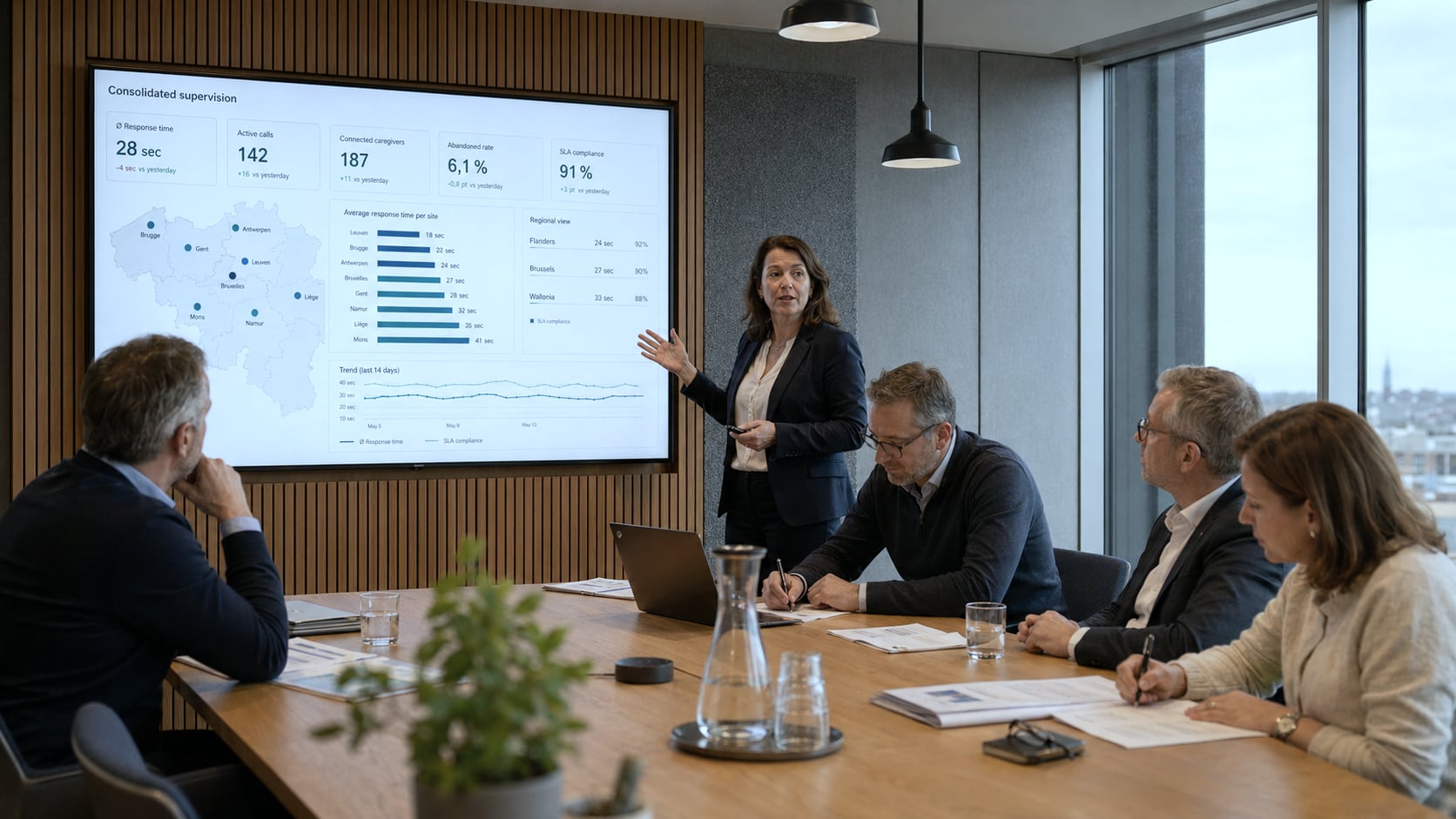
    Single dashboard for the regional or group management. Per-facility partitioning, multi-level rights (site / region / group). Consolidated KPIs without nominative exposure between sites. Configurable per facility size.

  • Unified DPO documentation

    Single GDPR DPA at group level, configurable retention periods per data type, AViQ + CoCoM + Zorginspectie reports extractable from the same dashboard. Your DPO has a single technical entry point.

  • Local server per site, central cluster

    Local server per site for critical safety functions (call, signal lamp, carer terminal smartphone or DECT), synchronised with premium private cluster (triple database). Scales without rupture from 5 to 50 sites. No big bang, no total overhaul.

Multi-site dashboard — per-facility partitioning, consolidated regional KPIs, unified group SLA. Illustrative visual (client shoot to be produced).

Field feedback — Belgian 5-care-home group

Anonymised profile: Belgian group of five care homes, between 60 and 110 beds per site, inheriting a fleet composed of three different systems (old wired on 2 sites, proprietary DECT on 2 sites, local integrator software on the 5th).

“Migrating five facilities to a unified system seemed too risky. The waves model with reference pilot reassured us. The first site went into production in 2 months, the four others followed at a 3-month rhythm. Result one year later: one DPO documentation, two technical interlocutors instead of nine, a regional supervision dashboard usable from my office. Carers moving between sites no longer relearn anything.”

Group operations director, 5 Belgian care homes (verbatim to validate after written authorisation, full client case D10)

See the three full client cases → · view the complete ecosystem.

Frequently asked questions

What contractual SLA does Healthcall offer to a multi-site group?
We contractualise a high-availability SLA at the level of the private cluster hosted at a Belgian premium host, backed by triple database mirroring and server redundancy. Detailed commitments — time slots, intervention delays, priority levels, escalations, possible penalties — are in the group framework contract. Critical safety functions (call, signal lamp, carer phone) run locally on each facility: an internet outage never takes a site out of service. Real uptime measurement is being instrumented via Zabbix, with verifiable figures planned for M+3 to M+6.
How are the data of different group facilities partitioned?
Each facility has its own logical space, with strict partitioning of resident and carer data. Group-level consolidation (reports, benchmarks, KPIs) goes through configured aggregated views, with no nominative exposure from one site to another. Accesses are traced per user, per device and per facility. The governance model distinguishes three authorisation levels: site (head nurse, local management), region (territorial management), group (CEO, CFO, CIO, DPO). The GDPR data processing agreement is unified at group level.
Do you provide a compliance certificate for AViQ, Zorginspectie or external DPO audits?
Yes. We provide at signing comprehensive technical and organisational documentation: application architecture, security measures, backup policy, breach notification procedures, configured retention periods, traceability evidence. This documentation is aligned with AViQ (Wallonia), Zorginspectie (Flanders) and COCOM (Brussels) requirements, as well as GDPR and Belgian health data legislation. For recurring audits, we provide directly the extracts requested by your DPO or external auditor, without going through local managements.
Can carer accounts be managed centrally across all facilities?
Yes. Administration of carer accounts, roles and rights is available at two levels: local (per facility, for daily management) and group (for internal mobility, unified access policies, departures and arrivals). Security parameters — password complexity, rotation, logging, identity federation — are defined by your CIO at group level and applied automatically at each site. Mobility of a carer from one facility to another is handled by assignment, with no account recreation.
Does Healthcall integrate with our healthcare ERP or computerised care record?
Yes, via API and dedicated connectors. The most frequent integrations concern computerised care records (performed acts, rounds, mobilisations), HR ERPs (carer directory, schedules) and billing tools (stays, technical consumption). Each integration is the subject of upstream technical scoping and an addendum to the group contract. Our open architecture and our independent non-manufacturer integrator positioning make these connections natural — we do not impose any closed proprietary format. The GDPR exchange framework is formalised in a specific addendum to the data processing agreement.
How does the migration of a facility equipped with an old proprietary system go?
We start with a free site-by-site technical audit: existing cabling, reusable field equipment, integrations to preserve, architectural constraints, intervention windows compatible with activity. Depending on diagnosis, three scenarios are considered: full removal and new install (standard scenario, two days), partial reuse of compatible buttons or signal lamps, or transitional dual layer during a pilot phase. Our clients have migrated from old wired systems (Bosch, Ackermann) and from proprietary DECT systems (Televic, Ascom), without service interruption. For a group, the rollout is sequenced in waves, with experience feedback between sites.
What is the typical scale of a group migration programme over five to ten facilities?
A group programme typically spreads over six to twelve months depending on fleet size and coexistence with current contracts of historical suppliers. The standard sequence comprises: strategic scoping with the management committee (one month), pilot on a reference site (two months, activation and field feedback), synchronised deployment waves (three to nine months, two to four sites per wave), closure and performance measurement (one month). Each site stays at two working days of technical switchover — what stretches is coordination, training and integrations with your group tools.

Let's discuss your project

A demo tailored to your care home, without commitment. Thirty minutes to clarify your needs.