Professional building automation for care homes: control, scenarios and energy
Professional building automation for Belgian care homes: lighting, heating, roller blinds, ventilation, emergency scenarios and energy optimisation. Shelly, Pragma, Sonitor integrations.
What is Healthcall professional building automation?
Healthcall professional building automation is a control module integrated into your nurse call ecosystem, designed for the daily reality of the care home: adaptive corridor lighting, zone heating, automated blinds, fire emergency scenarios, energy optimisation. The architecture relies on open Shelly, Pragma and Sonitor equipment, no proprietary catalogue imposed.
The module shares the same local server and the same routing rules as nurse call. A night call in a room can automatically trigger an accompanying lighting to reduce risers' fall risk. A fall detection can light up the room and corridor to ease intervention. Each scenario is configurable in the same interface, no third-party connector.
Each function activates per your context. Modular approach allows starting with one floor or one type of function, then extending.
Adaptive corridor lighting
Presence detection + ambient luminosity. Daytime: comfort lighting per occupancy. Night: low-intensity wayfinding, automatic boost on detected call. Energy savings on common-area lighting often 30-50%.
Zone heating
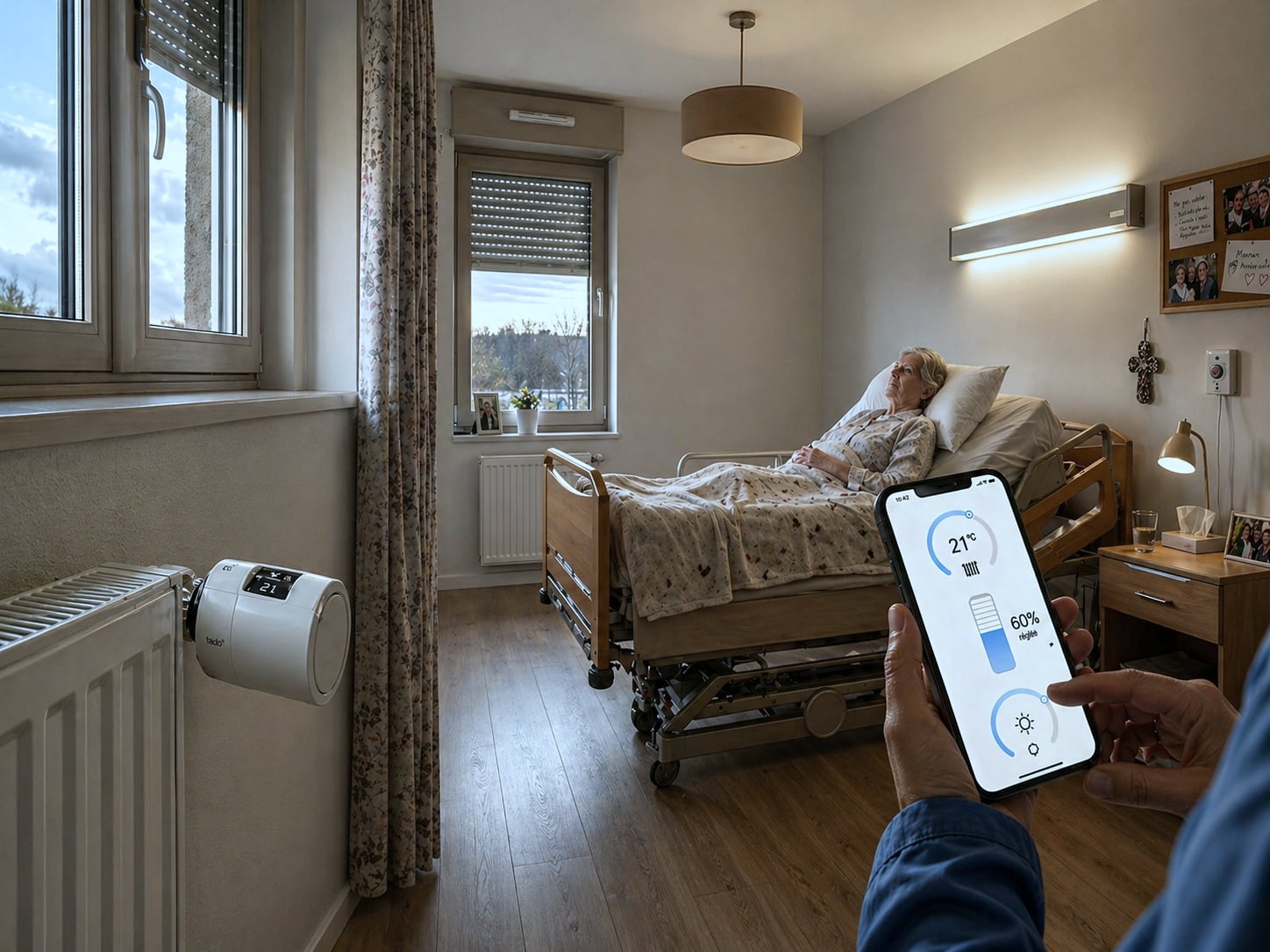
Connected thermostatic heads per room or central regulation interfacing (Modbus, KNX). Empty/occupied detection coupled with calendar. Override possible by carer for particular comfort.
Fire evacuation scenarios
Coupling to fire panel via dry contact or IP. Auto-triggered: evacuation path lit, controlled doors unlocked, non-essential ventilation cut. Schematics provided to fire advisor at commissioning.
Nurse call coupling
Night call → room nightlight + approach corridor lit at 50%. Fall detection → full lighting. Refusal action log → next-morning blind raise. Configurable in same interface.
Energy reporting
Monthly consumption per zone, type, time slot. PDF/CSV exports for accounting and conseil d'administration. ROI objectivised over 12-24 months on existing baseline.
No-trenching modular install
Shelly modules in existing flush boxes behind switches and outlets. Wi-Fi or Bluetooth mesh radio control. No false ceiling reopening, no luminaire imposed.
Visual coming soon
Care home corridor with discreet wayfinding lighting controlled by night automation, occupied room visible at end
Adaptive night corridor lighting, saves energy and reduces resident fall risk. Illustrative visual (client shoot to be produced).
3 scenes from equipped care homes
Pilot floor, corridor lighting first
A 60-bed care home starts with night adaptive corridor lighting only. Within 3 weeks, teams observe a fall reduction at room exit (better visibility), and within 6 months, a measurable common-area lighting consumption reduction. Decision to extend to zone heating in the second phase.
Fire scenario, main corridor + locks unlocked
3:30 am. The fire panel detects smoke in the kitchen. Healthcall building automation receives the event: floor 1 corridor and main exit corridor lit at 100%, controlled doors unlocked, non-essential ventilation cut. SSI continues autonomously to ring sirens and signal compartments. Carers and rescuers find a lit, accessible path. Auto-trigger in 2 seconds, fully traced.
Night call → resident-friendly lighting
11:45 pm. Mrs L. presses the call button. The system, beyond standard nurse call routing, lights the bathroom nightlight at 30%, the access corridor at 40%. The carer arrives, room and corridor lit gently. Mrs L. walks in confidence, no falling in the dark on getting up.
Building automation does not stand alone
Same server, same rules, same supervision as the rest of the ecosystem.
Nurse call
Native coupling. A call triggers an automation scenario depending on the call type and time slot. Zero third-party connector.
Access control
Common rules. Fire scenario unlocks controlled doors, BLE wristband enables zone access, carer badge keeps current operation.
Fall detection
Full lighting on detected fall. Carer arrives in good visibility, intervention faster. Saved time = better resident outcome.
Central supervision
Active scenarios visible in real time on the dashboard. Manual scenario triggering possible for the head nurse from the same screen.
Is Healthcall building automation compatible with an old building?
Yes, in the vast majority of cases. Our architecture relies on Shelly modules that fit directly into existing flush boxes, behind switches and outlets already in place. No wall trenching, no false ceiling reopening, no luminaire replacement imposed. Control is via Wi-Fi or Bluetooth mesh radio depending on zone. For listed care homes or recently renovated without automation provision, we carry out a technical survey before quoting: cabling type, neutral availability at control points, breaker state. In rare cases where a control point cannot be equipped without works, we flag it and you arbitrate, no hidden surcharge during the build.
What energy savings to actually expect?
Savings depend on three factors: existing building quality, regulation already in place, usage discipline. Best documented sources of savings on our installations concern zone heating (empty or unoccupied rooms during the day) and common-area lighting (corridors, sanitary) thanks to presence detection. We do not communicate a universal average figure, too dependent on your starting point. We do provide monthly consumption reports per zone, which let you objectivise the return on investment over 12 to 24 months. Exact calculation is done at audit, with your current energy bill and a reading of your existing regulations.
Who handles building automation equipment maintenance?
Software maintenance (rules, scenarios, module firmware updates) is included in your Healthcall contract like the other modules: four major updates per year, no surcharge. Hardware maintenance follows ecosystem logic: replacement of a faulty Shelly module within 48 working hours, part supplied and installed by our team or your partner electrician per your preference. Pragma and Sonitor equipment is covered by their manufacturer warranty, relayed by us. We are not manufacturers, you are therefore never locked into a proprietary catalogue for a simple replacement part.
Can existing heating regulation be kept?
Yes, in most configurations. If your care home already has a recent central regulation (outdoor probe, zone programming, motorised V3V valve), Healthcall interfaces with it via standard protocols (Modbus, KNX as applicable) to add room-level granularity. If regulation is old or binary (all or nothing per floor), we propose a complementary deployment of connected thermostatic heads per room, controlled by our scenarios. Both approaches can coexist during a pilot phase. The technical audit specifies which is relevant for your building and heat source.
Does building automation respect Belgian fire safety standards?
Yes. Fire emergency scenarios are designed as a complement, never a replacement, for your regulatory fire detection system (SSI, detectors, sirens, compartmenting). Healthcall building automation receives information from your fire panel via dry contact or IP protocol and triggers actions outside the SSI's scope: lighting the evacuation path, unlocking controlled doors outside emergency exits, cutting non-essential ventilation. In case of automation failure, the SSI continues to function autonomously, it is the fundamental non-dependence rule we strictly respect. Technical schematics are provided to your fire-prevention advisor before commissioning.
What is the link with nurse call?
The link is native: building automation and nurse call share the same local server and the same routing rules. A night call in a room automatically triggers a configurable accompanying lighting (room nightlight at 30%, approach corridor at 50%) to reduce the falls of the rising resident. A fall detection can trigger full lighting of the room and corridor to ease intervention. A call with refusal action log can raise the blinds the next morning to visually mark a preference. The integration requires no third-party connector, everything is set up in the same interface.
Can we start with a single pilot zone?
Yes. The modular approach lets you start with one floor, one wing or one function type (e.g. only night corridor adaptive lighting). You measure the result, your teams get used to it, then you extend. This trajectory is frequent with our clients, first common-area automation in synergy with nighttime nurse call, then zone heating once the energy audit is ready. Initial cost stays under control and you keep hand on deployment pace.