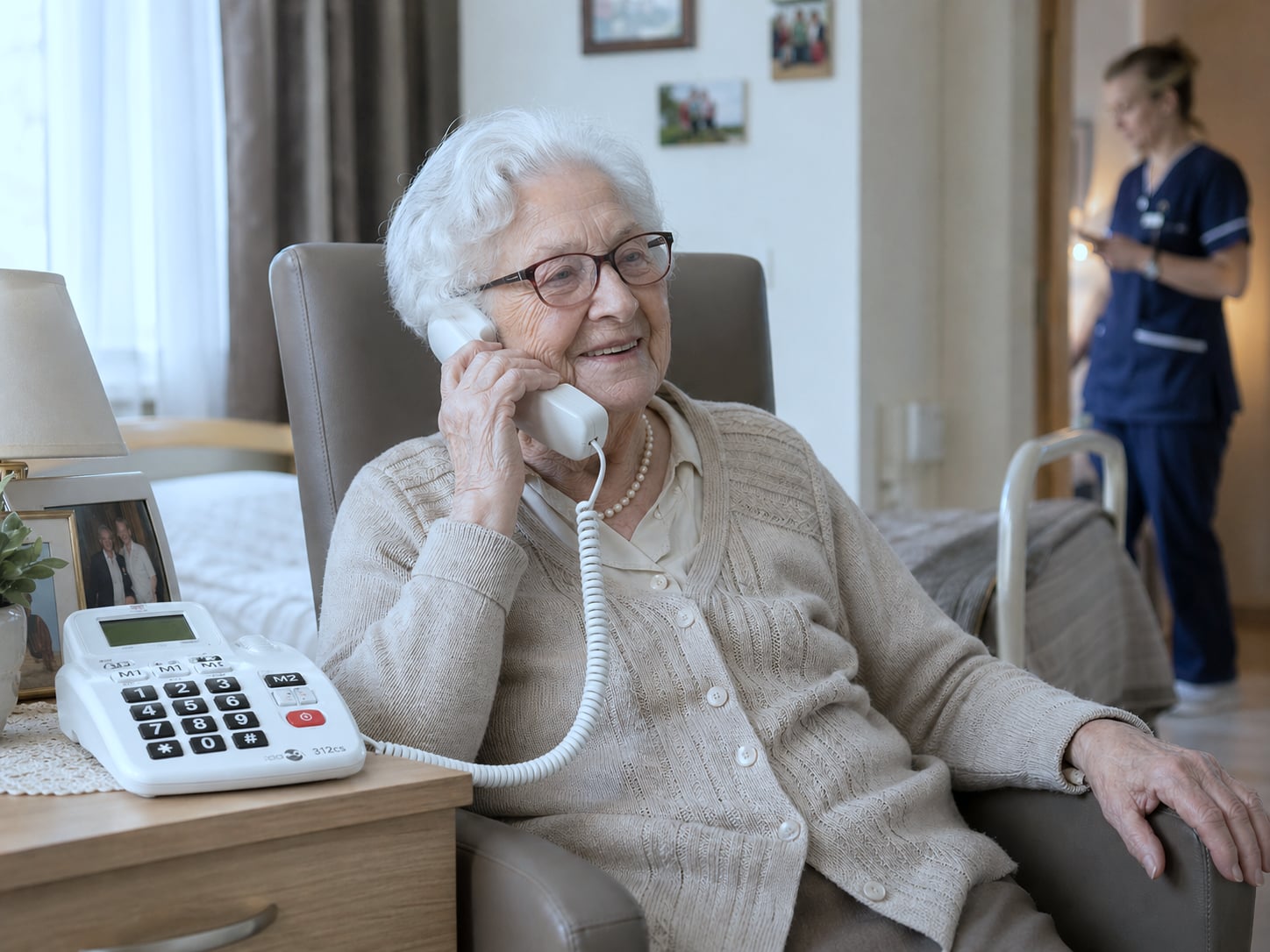
What is the Healthcall resident phone?
The Healthcall resident phone is a simplified phone terminal installed in the resident's room by the care home and configured by its team. It is exclusively addressed to care home managements wishing to offer a standardised phone service to their residents, at a controlled cost, without multiplying individual operator contracts.
The infrastructure relies on 3CX voice over IP shared at facility level, with Doro physical terminals chosen for their senior ergonomics, large keys, amplified sound volume, native hearing aid compatibility. Each device has configurable shortcut keys (family, referring carer, treating physician, chaplaincy, floor service), defined on resident entry by your head nurse.
-
85 dB
Ringing volume
listening amplification +30-40 dB above public standard
-
HAC + T loop
Hearing aids
compatible with most Belgian hearing aids
-
~15 min
Room activation
no operator step, from interface
-
0 € termination
Resident departure
number attached to room, not resident
For more: integration with nurse call · building access intercom.
Six features, one centralised fleet
The resident phone is not a consumer electronic product resold in the room. It is an equipment and administration service, designed for care home management.
-
Senior-adapted phones
Doro models, Swedish specialist manufacturer. Large contrasted keys (12-18 mm), strong-font backlit screen, ringing volume up to 85 dB, listening amplification 30-40 dB. Light handset, stable base, long coiled cord.
-
Configurable shortcut keys
Family, referring carer, treating physician, floor service, chaplaincy. Defined by your head nurse on entry. Adjustable anytime, no operator step. Photo of contact on screen for memory recognition.
-
Native nurse call integration
Emergency key identical to room call button, same notification chain to carer terminals (smartphone or DECT), same supervision dashboard. The resident phone is not a separate silo.
-
Anti-scam and anti-canvassing protection
Filtering of known canvassing prefixes, masked-call blocking, configurable night time slot, premium-rate number restrictions. Defined by management, adjustable from the administration interface.
-
Centralised group billing
Single monthly invoice in the care home's name, line-by-line consumption detail. No individual operator contract per resident. Number portability handled by Healthcall on each entry and exit.
-
Hearing aid compatibility
HAC marking, T-loop magnetic induction coupling. Reinforced ringing volume + flashing visual signalling for hearing-impaired residents. Terminal choice adjustable for special cases (profound deafness, unilateral cochlear).
Visual coming soon
Doro large-key phone next to a resident's bed in a care home room, natural lighting
3 scenes from the field
Resident hospitalised, line suspended in 3 clicks
Mr K., room 18, is hospitalised for one week. Your head nurse opens the administration interface, suspends the line, adds a note. The line is dormant: no incoming or outgoing call possible. On return, reactivation in 1 click. No operator step, no per-line termination fee, no double billing. The line returns instantly to operational state.
New resident with hearing aids
Mrs P., recently arrived, wears 2 hearing aids. The resident phone is HAC-compliant: the magnetic induction coupling activates automatically when the handset approaches the hearing aid. She hears clearly, without parasitic interference. Volume turned up by 30 dB above public standard. The flashing visual signalling reinforces the audio ringtone for her partial deafness.
Resident protected against night canvassing
11:30 pm. Mr V. occasionally receives canvassing calls late at night. The system detects the prefix (known telemarketing list) and routes the call directly to central supervision rather than ringing in the room. Night sleep preserved. The resident retains daytime call freedom but is protected from intrusive practices targeting vulnerable persons.
The resident phone integrates into the ecosystem
Unique 3CX central, shared with the nurse call and intercom modules. One contract, one supervision dashboard, one billing line.
-
Nurse call
Resident emergency key triggers identical chain to room button. Carers receive on smartphone or DECT, supervision shows the call. Same routing rules.
-
IP intercom
Same 3CX central. Reception intercom, corridor intercoms and resident phones share the protocol layer. Calls between rooms, calls to the floor, calls outside.
-
Carer phone
A doctor calling back the resident is transferred directly to the carer responsible. The head nurse can call the family from her smartphone or DECT. Single dial plan.
-
Central supervision
Active lines, line statuses, suspended numbers, monthly consumption. Management view, no per-resident detailed surveillance, purpose is fleet management, not behavioural tracking.
To discover all modules: see the full ecosystem · compare to other market solutions.