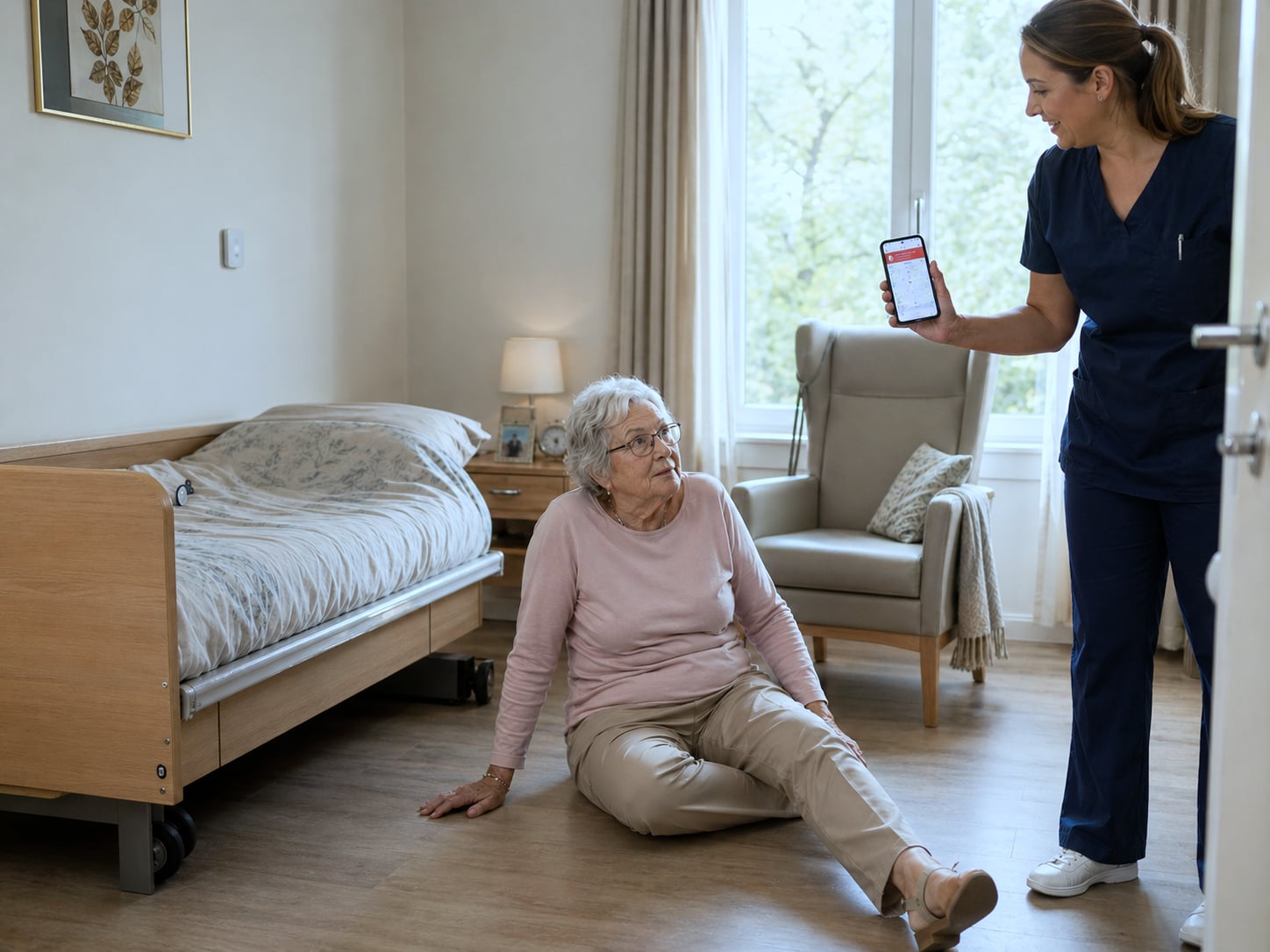
What is Healthcall fall detection?
Healthcall fall detection is a resident safety module that immediately signals a fall in the room or in an equipped zone, without the resident having to wear a device or trigger a call. It primarily relies on passive Vox floor sensors (slabs or wall sensors), optionally complemented by accelerometer wristbands for mobile residents.
Algorithms differentiate a real fall from a voluntary squat by cross-checking impact dynamics, time on floor and immobility signature, which reduces false alerts without sacrificing sensitivity. Each event is geolocated to the room or zone, timestamped to the millisecond, then routed to the nearest carer on their smartphone or DECT phone, through the same channel as nurse call, with critical priority. Central supervision sees the alert in real time.
The module fits into the Healthcall modular ecosystem, published by Groovit since 2017. The architecture is open: third-party sensors are integrated via independent integrator partnership, with no vendor lock-in.
-
< 1 min
Carer arrival
median delay observed in equipped care homes
-
868 MHz
Dedicated wireless network
no consumer Wi-Fi dependency
-
2 days
Installation
60-to-100-bed care home, no operational shutdown
-
0 camera
0 microphone
100% passive Vox sensors
For more: integration with nurse call · complete Healthcall ecosystem.
Six features, one coherent module
Fall detection is not a single technology but an assembly of sensors, algorithms and routing rules adapted to your building and resident profiles. Each feature can be activated according to your configuration.
-
Passive Vox floor sensors
Slabs or wall sensors installed at the foot of the bed, in circulation zones and risk points (bathroom, window). No device to wear. No-trenching install, long-life cell, no operational shutdown.
-
Optional accelerometer wristbands
For mobile residents. Combine vertical acceleration, tilt angle and post-event inactivity. Geolocated via BLE beacons shared with wandering prevention. Resident-by-resident choice.
-
Anti-false-alert algorithms
Signal cross-checking: impact dynamics, time on floor, immobility signature. Configurable thresholds per profile. Continuous learning based on carer action logging on room arrival.
-
Precise geolocation
Each fall geolocated to the room, zone (foot of bed, bathroom, corridor, garden). Critical information when the door is closed and the resident does not respond.
-
Native nurse call integration
Same technical base (868 MHz, BLE, carer terminal, local server), same carer interface. A fall arrives on the smartphone or DECT like a nurse call, critical priority. No separate software to stack.
-
History for prevention
Dashboard per room, time slot, resident profile, season. Cross-tabulation to identify risk zones and slots. PDF/CSV exports for AViQ, Zorginspectie, INAMI quality audits.
Visual coming soon
Bright care home resident room with floor at the foot of the bed, discreet integrated sensor
From detection to intervention, no gesture required
The sequence follows Healthcall's founding triptych: detection, decision, action. Each step is automated, timestamped and traced, without resident or carer having to manually trigger the alert.
- Detection
Sensor or wristband → qualified impact
The Vox sensor perceives the impact or the wristband detects abnormal vertical acceleration. Transmission to local server via 868 MHz or BLE, millisecond timestamp. No image or sound captured. The algorithm filters out false positives.
- Decision
Routing per configurable rules
Who receives the alert (floor carer, night, reinforcement), on which device (smartphone, DECT, supervision), escalation delay. A night room fall immediately triggers supervision. A common-zone fall during the day rings first on the nearest smartphone or DECT.
- Action
Carer on site + 3-sec action log
Alert "fall room 24, window side" on smartphone or DECT, priority ringtone, red signal lamp. One-button handover, other terminals silent. Automatic BLE presence detection. Action log on exit: confirmed fall, false alert, other.
4 scenarios observed in equipped care homes
The scenes below describe real situations. Durations are orders of magnitude measured in normal conditions; they vary according to your configuration.
Night fall in the room
2:47 am. Mr L., room 18, gets up to use the toilet and falls at the foot of the bed. He is disoriented and does not reach the call button. The Vox sensor perceives the impact, the algorithm confirms immobility on the floor beyond the threshold. Critical alert on the smartphone or DECT of the floor night carer, red signal lamp in front of room 18, simultaneous notification to central supervision. The carer arrives in 50 seconds, takes charge of the situation, calls reinforcement if needed. Action log "confirmed fall, no apparent injury" on exit. The event is traced for the morning handover and for the care plan.
Bathroom fall
10:15 am. Mrs R., room 12, slips coming out of the shower. The bathroom Vox sensor captures the fall, precise geolocation "room 12, bathroom" appears on the floor carer's smartphone or DECT. Valuable information: the bathroom door is closed, Mrs R. does not respond. The carer immediately knows where to head. Arrival in 40 seconds. The bathroom is a frequent fall point in care homes, particularly for autonomous residents whose falls are the quietest. The module's history shows the director that room 12 concentrates several bathroom events over the quarter, non-slip mat adjustment.
Corridor fall on the floor
4:30 pm. Mr B., a mobile resident equipped with an accelerometer wristband, falls in the 2nd floor corridor coming back from the lounge. The wristband detects vertical acceleration and post-event immobility. The corridor 2 BLE beacon geolocates the event. Critical alert on the carer terminals of the 2 nearest carers. The nearest one arrives in 25 seconds. Detection works where Vox sensors are not installed, it is the complementarity between both technologies that enables full coverage.
Recurrence analysis for prevention
Quarter-end. The head nurse consults the Healthcall dashboard and generates the fall report: 17 events over 3 months, including 12 confirmed falls and 5 qualified false alerts. Distribution: 8 night falls between 2 am and 5 am, 6 daytime bathroom falls, 3 corridor falls. 2 rooms concentrate 7 events alone, with resident profiles presenting particular fragility. The team adjusts: reinforced night lighting in those rooms, additional physiotherapy support, sensor repositioning in a room where a zone remained imperfectly covered. The report also serves as quality evidence for the following month's AViQ inspection.
Visual coming soon
Care worker in uniform in a bright care home corridor, holding a professional Android smartphone
Fall detection does not stand alone
The module shares its technical base with the eleven other Healthcall ecosystem modules, 868 MHz wireless network, BLE beacons, smartphones or DECT, local server, central supervision. Activatable on an existing nurse call installation.
-
Nurse call
Single channel to carers for all events, fall alerts, resident calls, emergency buttons. Same interface, same routing, same supervision.
-
Resident geolocation
Shared BLE beacons. Fall detection leverages this infrastructure to precisely locate events triggered by accelerometer wristbands.
-
Central supervision
Unified duty station: falls, calls, rounds, fire and intrusion alarms on a single screen with floor plan.
-
Wandering prevention
Shared BLE wristbands for residents concerned by both risks, without multiplying wrist-worn devices.
To discover all modules: see the full ecosystem · compare to other market solutions.