Scheduled care in care homes: Healthcall planning and traceability
Planning of recurring care in a care home: washing, medication, dressings, blood pressure. Timestamped traceability, non-execution alerts, INAMI/AViQ/Zorginspectie compliance reports.
Healthcall Scheduled Care is a module for planning and tracing recurring care in a care home: morning toilet, medication distribution, dressings, blood pressure measurements, mobilisations. Each care planned per resident, executed via guided checkbox on the carer phone (smartphone or DECT), timestamped to the minute, geolocated to the room by Bluetooth beacon. Non-execution alerts trigger after configurable delay, with escalation chain.
The module integrates natively with the rest of the ecosystem: same carer phone, same supervision dashboard, same single contract. It interfaces with main Belgian resident medical record software (Helena, Corilus Careconnect, Resident, Mediris) to avoid double entry.
The module is designed so the first pickup is done in real conditions, no painful onboarding, no thick manual. Each feature is activatable per your context.
Recurring planning per resident
Morning toilet, medication, dressings, mobilisations, vital signs. Plan in your EHR or natively in Healthcall. Variable frequency: every shift, daily, weekly. Editable by head nurse.
Guided action logging in 3 sec
Configured short list per act type (e.g. for dressing: clean / change / state) + optional free voice note. No keyboard typing, no double entry. Single tap on smartphone or DECT.
Non-execution alerts
Alert at 15 minutes default (configurable per act). Escalation: responsible carer → head nurse → supervision. Not punitive: safety net for high-load days.
EHR software integration
Helena, Corilus Careconnect, Resident, Mediris, certain Corhelia modules. Care plan ← EHR, executions → resident nursing record. API, CSV, HL7 FHIR depending on software.
Nurse-to-assistant delegation
Royal decree of 12 January 2006 framework. Per-act configuration: assistant / nurse only / written delegation. Tracing of delegations, supervision and legal liability remain with the delegating nurse.
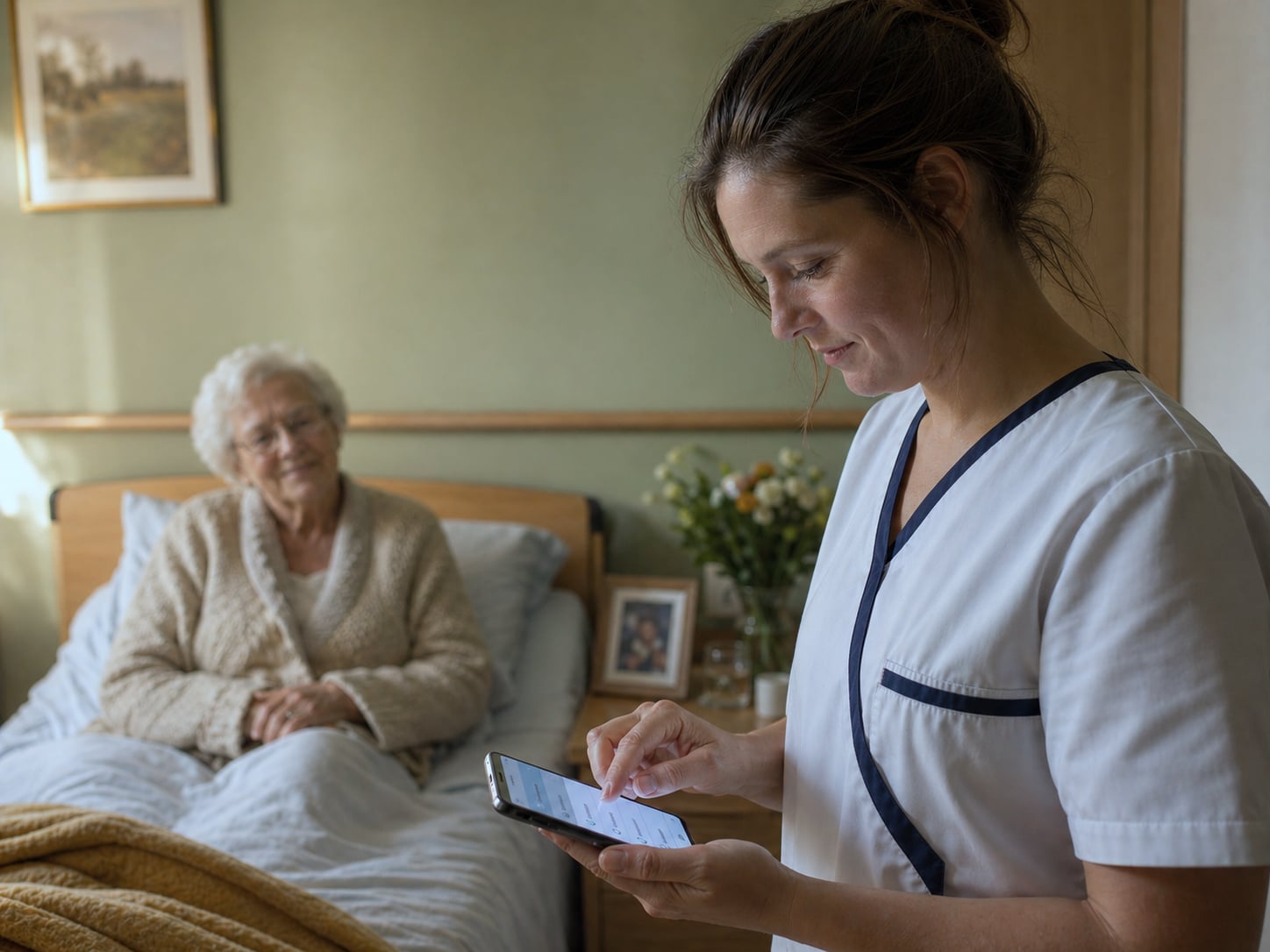
Care assistant ticking a scheduled care action on a professional Android smartphone in a care home resident room
Action logging in 3 seconds, guided checkboxes, no keyboard typing. Illustrative visual (client shoot to be produced).
3 scenes from equipped care homes
Morning round, 5 rooms in 22 min
Sophie, care assistant, starts her morning round at 7 am. She enters room 12, the BLE beacon detects her presence, the screen of her smartphone displays Mr V.'s scheduled care: morning toilet + bandage change. She performs, ticks 2 boxes in the short list, exits. Identity follows the phone, time and location automatically captured. 22 minutes for 5 rooms instead of 30 minutes with paper logbook.
Family dispute, extracted history
A family member claims their mother's afternoon care was not performed. The head nurse extracts the resident's history over 3 days from the dashboard: 47 timestamped, geolocated, signed actions. Care of disputed afternoon: 3:14 pm by carer Léa, room 24, action log 'mobilisation + state'. Dispute closed in 5 minutes. PDF export shared with the family for transparency.
Quarterly AViQ inspection prepared in 10 min
End of quarter. The head nurse generates the inspection report with one click: 8,400 actions over 3 months, 99.4% executed in time, 12 escalations triggered (all closed within the hour), top 3 most-frequent acts. PDF + CSV exports. Document directly usable for the inspection 2 weeks later.
Scheduled care does not stand alone
The module shares the same technical base as the other Healthcall modules. Activatable on an existing nurse call installation.
Nurse call
Same carer phone, same routing rules, same supervision dashboard. A nurse call action log can simultaneously validate a planned care.
Resident geolocation
Shared BLE beacons. Carer in-room presence automatically detected, no manual ID input. Saves time on every action log.
Central supervision
Today's care, executed actions, ongoing escalations, completion rate per team. Single screen for the head nurse to pilot.
Technical task management
Same logical workflow: declaration, tracing, closure. A care that requires technical equipment (lift, ventilator) is also flagged for maintenance.
Does Healthcall Scheduled Care integrate with our existing EHR software?
Yes, in the great majority of cases. We provide interfaces with the main resident medical record software used in Belgium (Helena, Corilus Careconnect, Resident, Mediris, some Corhelia modules depending on version). The goal is to avoid double entry: the care plan defined in your EHR feeds Healthcall, and executions traced by Healthcall come back into the resident nursing record. Integration mode depends on the software (API, scheduled CSV export, HL7 FHIR flow for the most recent). Pre-audit specifies possible exchanges and data still natively captured in Healthcall.
Are care data subject to GDPR? How are they protected?
Yes. Scheduled care data are health data within the meaning of GDPR article 9, subject to the reinforced regime of special categories. Healthcall processes them under article 28 GDPR data processing agreement provided at signing. Belgian hosting at a Belgian premium host (private cluster, triple database in mirroring, no EU exit, no US public cloud). Nominative logging of each access and change. Configurable retention period per data type, aligned with annex 120 of CRWASS (minimum two years after resident departure for the individual file).
How much training time should be planned for teams?
Half a day per business profile is sufficient. Standard plan: 90 minutes for care assistants (guided checkboxes, missed-care recovery, free short comment), 60 minutes for nurses (delegation, validation of delegated actions, refusal management), 60 minutes for the head nurse and management (plan configuration, reports, compliance dashboard). The module is designed so first pickup happens in real conditions, the carer sees today's care, ticks throughout the shift. A follow-up session at three weeks is included to adjust configuration to observed reality.
What happens if an unplanned care must be added during the day?
The carer adds the action directly from their phone, in the relevant resident's record, with timestamp and short reason (e.g. 'dressing redone after minor fall', 'extra blood pressure requested by physician'). The action is attached to the same traceability framework as scheduled care: who, when, what, where. It appears in reports the same way, with a 'unscheduled' marker to distinguish recurring from one-off actions. The head nurse can then decide to integrate this action into the resident's recurring care plan if the situation evolves.
How does delegation of care from nurse to assistant work?
Delegation of nursing acts to care assistants is governed in Belgium by the royal decree of 12 January 2006 on delegable nursing acts and the coordinated law of 10 May 2015 on healthcare professions. Healthcall picks up this framework: for each act, configuration specifies whether it can be performed by a care assistant, by a nurse only, or under written nominative delegation. When a nurse delegates an act to an identified care assistant for a specific resident, the delegation is traced (date, delegating nurse, delegated assistant, act and resident concerned). Supervision and legal liability remain with the delegating nurse.
What if a family disputes that a care was actually performed?
Each Healthcall-validated action carries a precise timestamp (to the minute), the ID of the carer who performed it, and the location (resident room confirmed by Bluetooth beacon read by the phone). These three elements form a robust evidence bundle, not absolute proof, but far superior to the classic paper logbook. In case of dispute, management can extract the resident's full history over a given period, with digitally signed PDF exports, exploitable in mediation or, if necessary, in proceedings. This traceability protects the facility, carers and, fundamentally, the resident.
Can reports be adapted to our specific needs (management, head nurse, inspection)?
Yes. Three report levels are delivered as standard and each is configurable. Daily report for the head nurse (executed acts, missed acts, recoveries, anomalies), weekly report for management (trends per team, floor, sensitive resident), inspection report extractable on free period for AViQ, Iriscare or Zorginspectie (full history signed, filterable by resident, act, carer). Templates are adjustable without technical intervention: your quality manager can add or remove columns, filters and alert thresholds. Exports come out in PDF and Excel.
What happens if a scheduled care is not ticked at the planned time?
A non-execution alert triggers after a configurable delay (default 15 minutes after planned time, configurable per act type). The alert first comes up on the resident's responsible carer's phone, then escalates to the head nurse after a second delay, then to central supervision. This escalation is not punitive: it exists to prevent an important care from slipping through on a busy day. In practice, it also acts as a safety net for night and weekend teams where mental load is higher. The trigger delay and escalation chain are adjustable to your organisation.