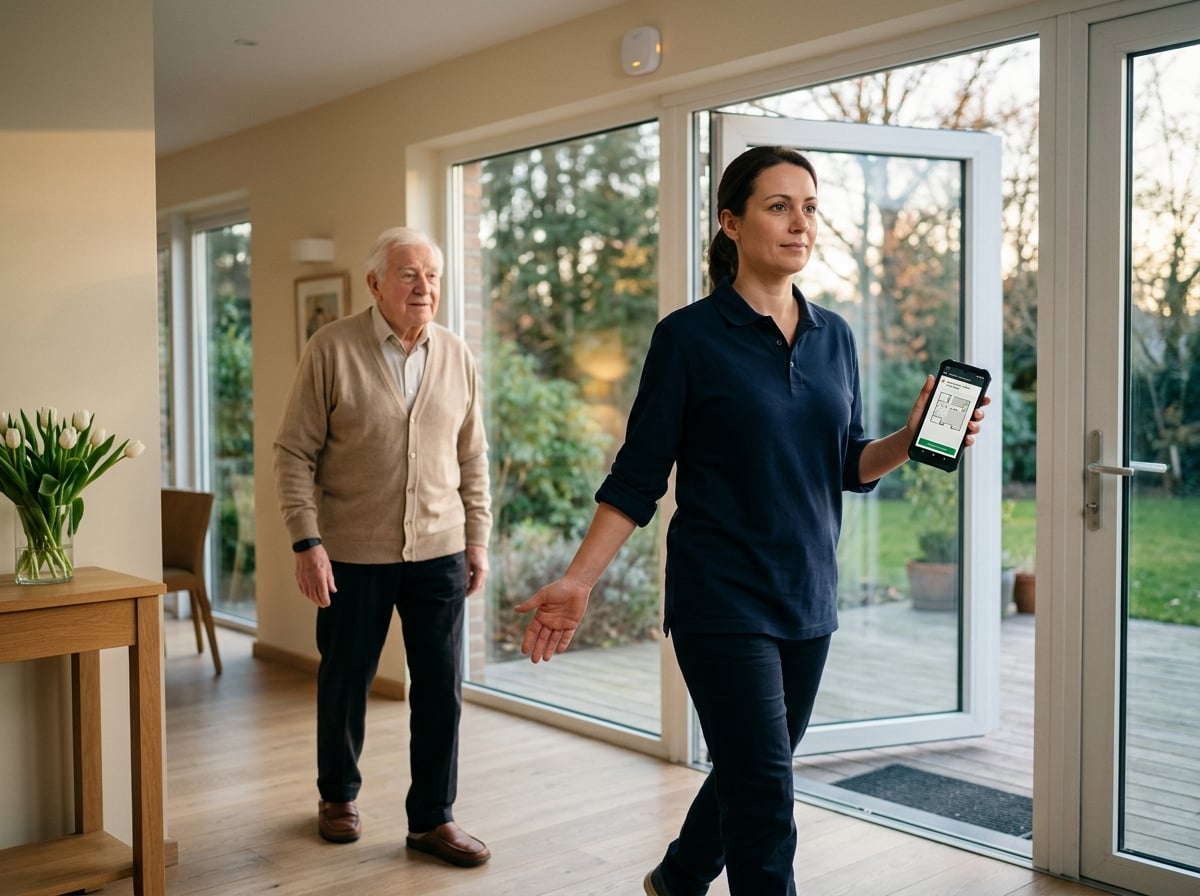
What is Healthcall wandering prevention?
Healthcall wandering prevention is an unauthorised-exit detection system for Belgian care homes. It combines Bluetooth Low Energy wristbands worn by the residents concerned, typically those with Alzheimer's or another form of dementia at risk of wandering, with beacons installed at strategic transit points: main exits, lifts, secured doors.
When a wristband-wearing resident crosses a critical point without authorised accompaniment, the system immediately triggers an alert on the terminal (smartphone or DECT) of the nearest carer, displays the precise location of the event on central supervision and, depending on configuration, temporarily locks the relevant door.
Healthcall has been equipping around twenty Belgian care homes of 30 to 150 beds since 2017, with an open architecture compatible with Blueup wristbands and equivalent BLE alternatives. Belgian hosting, high-availability private cluster.
-
< 2 sec
Crossing detection
from BLE signal to alert on smartphone or DECT
-
< 60 sec
First carer arrival
median delay observed in equipped care homes
-
3 to 5 yr
Beacon battery life
on cell, no cabling required
-
< 2 m
Indoor accuracy
in correctly meshed zones
For more: sister module, indoor resident geolocation · complete guide to AViQ regulation.
Six functions, one coherent system
The wandering prevention module shares its technical base with the entire Healthcall ecosystem: same BLE beacons as carer presence detection, same terminals (pro smartphone or DECT) as nurse call, same central supervision. You are not adding another silo, you are extending coherent coverage.
-
Comfortable BLE wristbands
Hypoallergenic medical silicone, secure fastening that cannot be undone, battery life from several months to several years. Wrist format by default, pendant / clip-on / ankle alternatives depending on the resident.
-
Beacons at strategic points
8 to 20 beacons for a 60-to-80-bed care home depending on building. Battery-powered, 3-to-5-year life, no cable. Densified mesh in thick load-bearing walls (one point every 10 to 15 m).
-
Immediate geolocated alert
Critical notification on the smartphone or DECT of the designated carer, supervision display with precise location (< 2 m), corridor signal lamp red, optional temporary door lock.
-
Configurable authorised zones
Enclosed garden, terrace, protected unit declared non-critical per profile. Safety must not come at the price of disproportionate autonomy restriction. Reconfiguration anytime from the dashboard.
-
Access control integration
Maglock, electric strikes, RFID readers, Ajax systems, standard IP controllers. Webhook to on-call SMS, CMMS, IP intercom. No silo: a single system.
-
Complete regulatory traceability
Timestamped logs exportable PDF/CSV: pairing, wear, crossings, alerts, doubt clearances. Three uses: internal management, GDPR article 30 compliance, AViQ inspection evidence.
Visual coming soon
Discreet medical wristband on the wrist of an older person, natural light, care home atmosphere
From crossing to doubt clearance in under a minute
Every wandering intervention follows the same sequence: a BLE signal is captured, a routing rule applies, a carer moves, an event is traced. The durations indicated are orders of magnitude observed in normal conditions.
- Detection
BLE signal → critical beacon
The wristband emits at regular intervals. As soon as a critical beacon captures it outside an authorised zone, a crossing event is generated. Second-accurate timestamp, beacon-level location. Whole chain in under 2 seconds.
- Alert
Priority routing to carer terminal
Critical notification on the smartphone or DECT of the floor carer, resident identity and beacon displayed. Without handover in 15-30 s, escalation to head nurse then supervision. Door delayed or locked depending on configuration. Corridor signal lamp red.
- Action
Doubt clearance + traceability
The carer moves to the indicated beacon, clears the doubt (alone exit, unidentified accompaniment, forgotten suspension), acts accordingly. Closure by short action log or voice note from the smartphone or DECT. Automatic history for dashboard and inspection.
For the overall view: see the full Healthcall ecosystem diagram.
4 scenes observed in equipped care homes
The scenarios below describe recurring situations in care homes. The durations indicated are orders of magnitude in normal conditions. First names are fictional; scenes draw on actually observed mechanics.
Alzheimer's resident exiting at night
2:47 am. Mrs J., resident of the protected unit, with moderate-stage Alzheimer's, opens her room door and heads towards the floor's main exit. She thinks she is going home. Her BLE wristband emits its signal. The beacon above the floor's airlock captures it. The zone is critical at night, the resident is alone, no smartphone/DECT pairing nearby: critical alert. The terminal (smartphone or DECT) of the night carer rings in 2 seconds, displaying the resident's first name and the crossed beacon. In parallel, the airlock door temporarily locks for 30 seconds. The carer arrives in 45 seconds, reassures Mrs J., walks her back to her room, closes the event with a voice action log. The next day, the head nurse adjusts night-time monitoring with the coordinating physician.
Newly admitted resident going to the garden
2:20 pm. Mr V., admitted 3 weeks ago, presents temporal disorientation but retains some autonomy. He leaves his armchair and heads to the enclosed garden. His wristband signals his passage via the beacon at the door leading to the garden. The garden being declared an authorised zone for his profile, no alert is triggered. He stays outside for 20 minutes, under the team's indirect surveillance. On returning to the building, the return beacon is simply traced, with no action. The Quality Charter is respected: freedom of movement preserved within a secured perimeter, safety ensured by garden fencing and the wristband which would have alerted if the main gate had been crossed.
Crossing at reception, doubt cleared by the front desk
11:05 am. Mrs F., with advanced dementia, heads towards the reception hall while her family is not expected. Her wristband crosses the hall beacon. Critical alert. The front-desk staff terminal and the floor carer's terminal ring simultaneously. The receptionist, already at the counter, can immediately engage in conversation with Mrs F. and cordially keep her there. The floor carer arrives in 40 seconds. Doubt clearance: the resident thought she had a medical appointment that she does not. She is walked to the common room, offered a diversion activity, event closed. The integration of wandering prevention and front-desk allows a two-level reaction, central for care homes with a hall opening onto the street.
False positive avoided by authorised zones
4:10 pm. Mr D., resident equipped with a wristband at his own request to reassure his family, moves freely through the ground-floor common areas. He passes in front of the central lift beacon. This beacon is declared non-critical for his profile: he has access to all floors and all common zones, he is fully oriented. No alert. Later in the afternoon, his daughter comes to pick him up for an outing. The carer temporarily suspends his wristband via the dashboard, with a traceable note. Mr D. and his daughter leave through the main door, the beacon detects him, but no alert is raised since the wristband is suspended. On return, the wristband is reactivated. No parasitic alert disturbed the teams.
Visual coming soon
Bright care home corridor with secured door and discreet signage
Wandering prevention does not stand alone
The module shares its technical base with the other Healthcall modules: same BLE beacons, same carer terminals, same central supervision, same local server. You are not stacking silos; you are extending a single system.
-
Indoor resident tracking
The sister module. Wandering prevention detects critical-point crossings; geolocation finds a disoriented resident with < 2 m accuracy. Same BLE layer, software activation, no new cabling.
-
Access control
Maglock, electric strikes, RFID readers. A detected crossing can delay or lock the relevant door. Native integration with Ajax and standard IP controllers.
-
Central supervision
A single screen for wandering alerts, nurse calls, fire alarms, night rounds, active carers. The duty station becomes a real control centre.
-
Nurse call
The base of the ecosystem. Wandering prevention uses the same terminals (smartphone or DECT), the same routing rules, the same multi-colour signal lamps. If Healthcall already equips your care home, activation is purely software-side.
To discover all modules and their interactions: see the full ecosystem · compare to other market solutions.