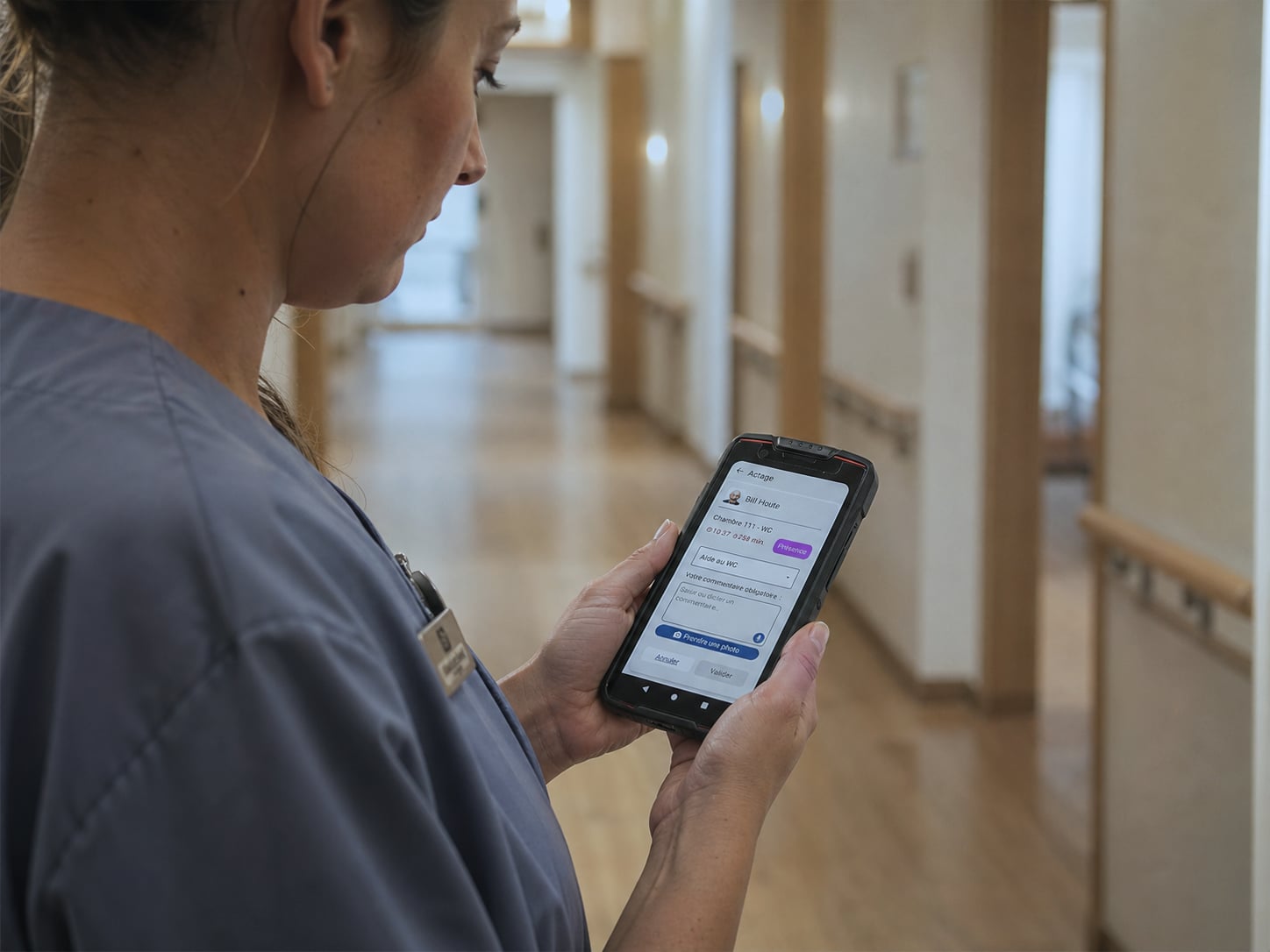
What is the Healthcall carer phone?
The carer phone is the terminal carried by each team member during their shift. It receives resident calls routed by the Healthcall system, enables handover in one gesture, triggers care action logging, broadcasts internal messages and embeds the carer emergency shortcut key.
Healthcall supports 2 device families. By default, we recommend the shared professional Android smartphone per duty station (Samsung XCover, Crosscall Core, CAT S, Sonim XP), rich touch screen, room photos for care traceability, contextual notifications, integrated video tutorials, coordinating physician video consultation, native Bluetooth Low Energy beacon reading. As a proven alternative, professional DECT phones (Snom M90, Grandstream WP825, Doro 8110) retain all their relevance: large physical buttons, highly readable monochrome screen, 12-18 hour battery life per shift, IP65 ruggedness, excellent ergonomics for continuous wet-gloved hands or noisy atmospheres.
Integration with the 3CX IP central enables both families to handle external calls (family, doctor, suppliers) with priority rules that preserve critical resident calls. Healthcall is an independent non-manufacturer integrator: we do not sell our own terminals, we choose the most relevant models for your residence and configure them with your business rules.
-
12-18 h
DECT battery life
pro smartphone 8-14 h, dock rotation recommended
-
IP65
Ruggedness + disinfectants
isopropyl alcohol, chlorhexidine, quaternary ammoniums
-
15-30 min
Carer training
login, handover, action logging, logout
-
48 h
Device replacement
service commitment, immediate loan if needed
For more: nurse call pillar module · resident phone on the bedroom side.
Six criteria that make the difference on the ground
The carer phone is held in hand ten to twelve hours a day. Every detail counts: button size, battery life, liquid resistance, business interface simplicity, and the ability to visually document an intervention.
-
Professional Android smartphone recommended
Samsung XCover, Crosscall Core, CAT S, Sonim XP, rugged Android IP65/IP68, centralised MDM, native encryption. Rich touch screen for resident record, room photos, contextual notifications, video tutorials, physician video.
-
DECT proven alternative
Snom M90 (European pro finish), Grandstream WP825 (value for money), Doro 8110 (XL keys). Better ergonomics for continuous wet-gloved hands, noisy environments, long battery life. Proven 3CX ecosystem since 2017.
-
3-gesture ergonomics blind
Emergency key, handover, hang up identifiable without looking. On smartphone, configurable physical side keys and locked home widgets. On DECT, native physical buttons usable gloved or wet-handed.
-
Long battery life + alert
Pro smartphone 8-14 h active use (dock rotation mid-shift), DECT 12-18 h active use, 80-120 h standby. Low-battery alert raised to supervision at 15%. Charging stations sized for one slot per terminal.
-
IP65 shock + disinfectant
Rugged smartphones certified IP65/IP68 (or certified IP65 case for standard models). DECT dustproof + low-pressure jets. Compatible hospital disinfectants. Shoulder-height drops covered (MIL-STD-810G).
-
3CX external integration
Family, doctor, suppliers on the same terminal. Priority rules: an external call is interrupted by an emergency button. Coordinating physician video consultation possible on smartphone. SIP-standard compatible for other brands.
Visual coming soon
Care worker consulting a nurse call alert on a professional Android smartphone showing resident name and call context
One shift, three key moments
The carer phone is not a standalone object: it fits into the full shift journey, from initial login to final call closure. Smartphone or DECT, the workflow is identical.
- Shift start
Login in 15 sec
The carer takes a terminal from the charging station, presses login, enters a short code or approaches their BLE badge. Business profile loaded instantly. Integrated timeclock. Immediate appearance on central supervision.
- During shift
Handover + action logging
Contextual ringtone (standard, urgent, bathroom). Room, type, resident name displayed, enriched with a room photo on smartphone. One press stops ringing on all other terminals. Action logging on exit in 2 seconds.
- Shift end
Logout + handover
Puts down the terminal, presses logout, confirms. Timeclock records the exit. No nominative data remains on the phone, native GDPR, selective MDM wipe on smartphone. The terminal is immediately available for the next shift.
4 situations that structure the choice of phone
Visual traceability of an intervention (smartphone-first)
2:20 pm. Léa, care assistant, intervenes with Mr D. who presents an unusual redness on the arm. From her professional smartphone, she takes a photo of the affected zone, attaches it to the action log and sends it to the resident's care record. The coordinating physician consults the visual trace during his weekly visit without waiting for a physical examination. Photo traceability becomes a clinical and medico-legal asset. Impossible on DECT, one of the cases where smartphone clearly prevails.
Video tutorial and coordinating physician video (smartphone-first)
Stefanie, recently hired, must perform a specific technical gesture for the first time. From the home screen of her pro smartphone, she consults the 45-second video tutorial integrated into the News/Messaging module. Gesture validated, she intervenes. That same evening, the coordinating physician launches a video consultation from his office with Sophie, head nurse, to review the protocol for an end-of-life resident, directly on the carer smartphone, without additional equipment. The phone becomes a full-range clinical tool.
Night team alone on a floor (DECT remains relevant)
During night shifts, a single carer sometimes covers an entire floor. DECT remains a solid choice here: physical buttons identifiable in the dark of a corridor without needing to look at a touch screen, 12-18 hour battery life that covers the full shift without dock rotation, contextual ringtone and emergency button accessible without visual interaction. If your Wi-Fi architecture is degraded in certain old wings of the building, the dedicated 868 MHz/DECT coverage takes over without weakening. The Android smartphone remains possible, but DECT keeps a clear advantage in this specific case.
Duty station rotation and shared per station
An 80-bed care home with day/night rotation and weekend teams counts 25 to 35 distinct carers on the monthly headcount. The "one terminal per duty station" model, typically 6 to 10 pro smartphones or DECT handsets for such a care home, avoids buying a phone per physical person. Each carer logs into the available terminal, their identity follows their login until logout. Systematic disinfection between each handover and charging of the terminal are enough for continuity. Substantial hardware savings, managed hygiene, GDPR rule respected (smartphone SHARED per station, not PERSONAL).
Visual coming soon
Mixed charging station in a care home nursing office, professional Android smartphones and DECT phones aligned for handover
The carer phone does not exist in isolation
It is the physical exit point of the nurse call system, inseparable from the eleven sub-functions of the pillar module. Each sub-function expresses itself on the phone, at the right granularity, at the right moment.
-
Nurse call
Pillar module. The carer terminal is the exit point of the whole chain: login/logout, action logging, BLE presence, multi-colour signal lamp, night round, emergency button, news/messaging.
-
Resident phone
Same 3CX central as the carer phone. Short internal dialing, smooth call transfers, single directory. The resident phone emergency key rings on the carer terminal.
-
IP intercom
SIP corridor, room-entry and main-entry stations. The carer terminal receives intercom calls and triggers remote door unlocking. Two-way audio to talk to the resident before moving.
-
Central supervision
The carer terminal feeds the real-time dashboard that lets the head nurse arbitrate reinforcements, understand real load and export activity reports.
To discover all modules: see the full ecosystem · compare telephony technologies.