What is Healthcall nurse call?
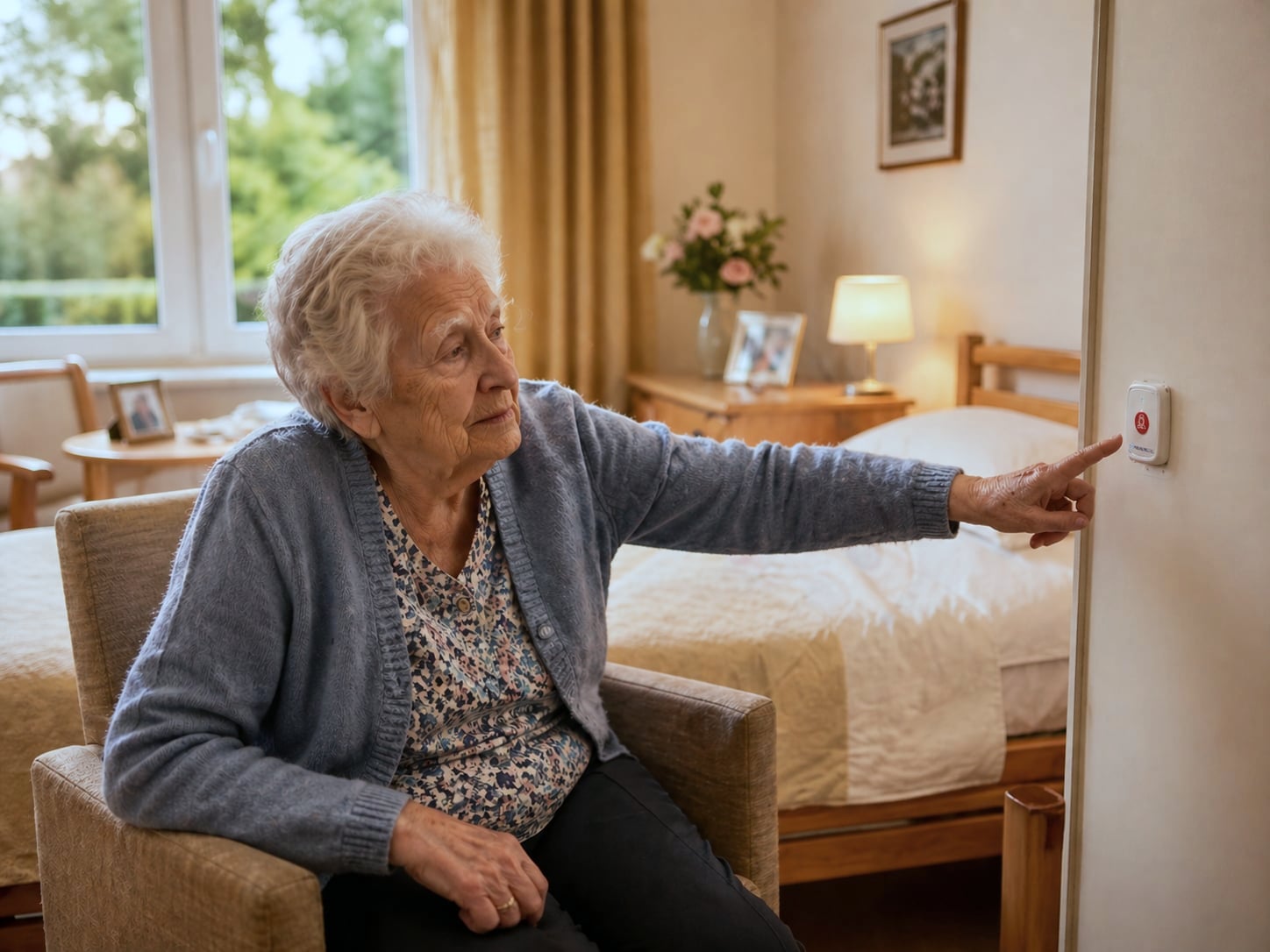
Healthcall is a nurse call system for Belgian care homes, published by Groovit since 2017. It enables a resident, a carer or a contextual sensor to trigger an alert, then routes that alert to the right person on their professional smartphone or DECT phone, and traces every intervention end-to-end.
Unlike hospital nurse call systems adapted after the fact to care homes, Healthcall was designed from the outset for the realities of the Belgian care home: small teams, individual rooms, AViQ and Woonzorgdecreet constraints, long-term residence, limited night-time presence. The product today equips around twenty facilities of 30 to 150 beds, securing the daily life of approximately 1,250 residents.
The system runs locally on an on-site server, synchronised with a high-availability private cluster hosted in Belgium at a Belgian premium host. 4 major updates are included each year, with no evolution surcharge, no paid migration, no stuck software generation.
-
8 years
Healthcall in production
since 2017, first client still active
-
20+ care homes
Trusted installed base
~1,250 residents, 1 departure in 8 years
-
100% BE
Data sovereignty
premium private cluster, triple database
-
4 updates/yr
Included
zero migration cost, no stuck generation
For more: complete Healthcall ecosystem · our independent integrator positioning.
Detection → Decision → Action: three simple gestures, thousands of times per day
Every intervention in a care home follows the same sequence. A signal appears, a decision is made, an action is executed. Healthcall orchestrates these three moments under a single rule: alert the right person, at the right moment, with the right information.
- Detection
Trigger → timestamp
Room push button, bathroom pull cord, fall sensor, BLE wandering beacon, voice command, carer emergency button on smartphone or DECT. Sensors coexist. Millisecond-accurate timestamp, immediate routing to decision, with no loss, even without internet.
- Decision
Configurable rules
Who receives? On which device? What escalation delay? Rules per floor, day/night team, call type, urgency, availability. A bathroom emergency does not ring like a comfort call. A night call escalates faster than a day call. The rules are yours.
- Action
Handover + traceability
Carer takes the call with one button press, goes to the room. Automatic BLE entry detection, care action logging of the gesture performed, exit time. Every intervention feeds the real-time dashboard and reports. Data becomes the basis for continuous improvement.
Five principles, eight years of practice
Healthcall is not an aggregate of features stacked up over requests. Every feature is evaluated against five principles, laid down with the care teams of the first care homes equipped in 2017.
-
Communication
Smooth exchanges between residents, carers and families without replacing them. Natural gesture for each. Family mentioned as indirect beneficiary, never addressed in the tool, Healthcall remains strictly professional.
-
Knowledge
Capture, structure, restore the data. Traces serving work organisation, not carer surveillance. Quality proof for AViQ, Zorginspectie, INAMI. Data belongs to your care home, exportable.
-
Integration
Your care home is not a blank page. Healthcall interfaces with existing systems (telephone central, smartphone fleet, DECT fleet, network, old buttons, access control). No total overhaul imposed. A consequence of the non-manufacturer independence.
-
Optimisation
Reduce unnecessary movements, visible handover, automatic presence detection, multi-colour signal lamp readable at distance. Free up care time for residents who really need it.
-
Reaction
Alert the right person, at the right moment, with the right information. Differentiated rules: standard call, bathroom, urgent, night, geolocated carer emergency button. Never standardised, follows your priorities.
Visual coming soon
Care worker handling a call from a professional Android smartphone in a care home corridor, Healthcall installation
Eleven sub-functions, one coherent system
Where most competing systems bill each function separately or force layering of third-party software, Healthcall integrates eleven sub-functions under a single interface, a single contract, a single update.
-
1. Carer login / logout
Connection on shared professional Android smartphone or DECT of choice (short code or BLE badge). Business profile loaded (day, night, head nurse, technician). Hardware circulates, identity follows. No more named phones.
-
2. Care action logging
Intervention reason captured in seconds: voice dictation (transcribed), configured short list, or free note. Timestamped, linked to carer and room. Feeds the care record, supports AViQ and Woonzorgdecreet.
-
3. Call handover
One button, all other terminals stop ringing. Visual display: the call is taken by this carer. No more redundant movements. Readable in corridors (green signal lamp) and at supervision. Changes organisational culture.
-
4. Automatic presence
BLE beacons on the ceiling of each room. The smartphone or DECT detects entry/exit, no manual action. Knows who entered, when, how long. Call closure without additional input.
-
5. Multi-colour signal lamp
Corridor light signalling: green (handled), red (urgent unhandled), blue (technical), yellow (logistics). A carer understands at a glance the state of each room without consulting their terminal.
-
6. Real-time dashboard
Supervision station, tablet or head nurse smartphone: ongoing calls, 24h history, active carers, technical alarms, network health. The head nurse arbitrates reinforcements, understands real load. Not a punitive surveillance tool.
The 5 other sub-functions complete the pillar:
- Integrated timeclock, login/logout also serves as time tracking. No more physical badge timeclocks or double entries. Exports compatible with payroll (CSV, API). Monthly reconciliation in minutes instead of half a day.
- Configurable reports, PDF/CSV with cross-filters (period, team, type, duration, carer, floor). Predefined standard reports + bespoke on request. Compliance AViQ, Zorginspectie, INAMI audits. No generation or storage cost.
- Automated night rounds, theoretical path, BLE presence validation (no badge), alert if room not visited in the window. Complete history required by regulators and insurers. Safety also for night carers.
- Carer emergency button, shortcut key, geolocation via nearest BLE beacon, priority notification of reinforcements + supervision. First reinforcement typically < 60 seconds. Central for night shifts and advanced Alzheimer's profiles.
- News / messaging, service notes, health alerts, procedure reminders, short video tutorials consultable directly on the smartphone home screen. Read acknowledgement traced. Replaces paper displays in break rooms and messages lost in handover notebooks.
-
2 days
Care home installation
60 to 100 beds, no operational shutdown
-
< 60 sec
First reinforcement
on geolocated carer emergency button
-
50 €
Excl. VAT per button
transparent public pricing, line-by-line quote
-
4 techs
Supported layers
868 MHz, Wi-Fi, BLE, traditional cabling
Four technologies, depending on your building
No single technology suits 100% of care homes. The choice depends on the building, budget, equipment density, thick walls. Healthcall assembles the optimal combination, a direct consequence of our independent non-manufacturer integrator positioning.
-
868 MHz wireless
European free IoT frequency. 50-150 m indoor range, decent wall penetration, low consumption. Reference for renovated care homes without running cable. Compatible with Blueup, Ajax, Lehmann.
-
Secure Wi-Fi (802.11ac/ax)
VLAN dedicated to medical equipment, WPA3 or EAP-TLS certificates. For professional Android smartphones, supervision tablets, DECT-IP, IP cameras. High-density Ubiquiti UniFi access points. Coexists with visitor Wi-Fi without traffic mixing.
-
Bluetooth Beacon (BLE)
Ceiling beacons + strategic points (bathrooms, exits). 5-20 m range, 3-5 year battery life. Essential for carer presence, indoor geolocation, automated night rounds. Partners: Blueup, Sonitor.
-
Traditional cabling
For care homes with historical bus or new-build imposing wired (fire compliance, architect preference). Interfacing if protocols allow, or new structured cabling. Minority option but sometimes the right answer.
For a complete technical comparison across 17 criteria: guide to nurse call technologies.
Visual coming soon
Wireless wall call button and bathroom pull cord in a care home resident room
4 scenarios, one single system
Call button in the room, in the middle of the night
3:14 am. Mrs D., room 24, presses the button above her bed. She needs help to get up. The system captures the signal, applies the night rules: priority ringing on the floor night carer's terminal (shared professional smartphone or DECT depending on site equipment, no immediate escalation since only one carer), red signal lamp in front of room 24, discreet notification to central supervision. The carer takes the call in 4 seconds, the signal lamp turns green. Arrival in the room in 40 seconds, automatic BLE detection, traceability is complete without any additional gesture. Voice action logging "mobilisation" on exit. Total chain duration: less than 2 minutes for a non-urgent need.
Presence detection without manual logging
Morning round cycle. Sophie, care assistant, moves through 5 rooms in 20 minutes. In each room, the BLE beacon detects her entry and exit, no gesture on her smartphone, no badge to check in. While she is toileting Mr V., a call arrives from the neighbouring room: the system notes she is already busy in room 12 and routes the call to her colleague on the upper floor. This simple arbitration, invisible to residents and carers, avoids parasitic movements. At the end of the round, a single global action log "morning round" is entered for all visited rooms.
Monthly report to management
End of month. The director consults the Healthcall dashboard and generates in one click the standard monthly report: 1,847 handled calls, median response time 42 seconds, 94% of calls handled in under 60 seconds, breakdown by floor and team, top 5 most-calling rooms. She exports the PDF for the board and the CSV for her management spreadsheet. To prepare an AViQ inspection scheduled 2 weeks later, she also extracts action logs and night rounds for the quarter. Generation is instant, no cost, no technical dependency.
Carer emergency reinforcement
6:50 pm. Pierre, evening nurse, is alone in room 31 with a disoriented resident who has become agitated. He presses the emergency shortcut on his professional smartphone for 2 seconds. The system geolocates his position via the room BLE beacon, triggers a critical alert on the terminals of the 2 nearest carers (upper floor), and shows a red status on central supervision. First reinforcement arrives in 35 seconds, second in 55 seconds. The incident is automatically traced: timestamp, carers involved, room, resolution time. The next day, the head nurse reviews with Pierre and adjusts the routing rules or evening team composition if necessary.
Nurse call is the heart: not the boundary
Nurse call is the historical pillar module of Healthcall. It shares its technical base with the eleven other ecosystem modules, letting you progressively extend functional coverage without migration, dual cabling or new contract.
-
Wandering prevention
BLE wristbands on the resident concerned, beacons at transit points (exits, lifts, secured doors). Immediate alert on crossing, with indoor geolocation.
-
Fall detection
Vox floor sensors or wristbands equipped with accelerometer. Instant notification to the nearest carer via the same channel as nurse call.
-
Central supervision
Unified duty station: all calls, all alarms, all rounds, all active carers on a single screen. Fire and intrusion alarm integration.
-
Carer phone
Choice and integration of the professional Android smartphone or DECT fleet, network cabling, MDM and training. Technical module complementing the nurse call software.
To discover all modules: see the full ecosystem · compare to other market solutions.