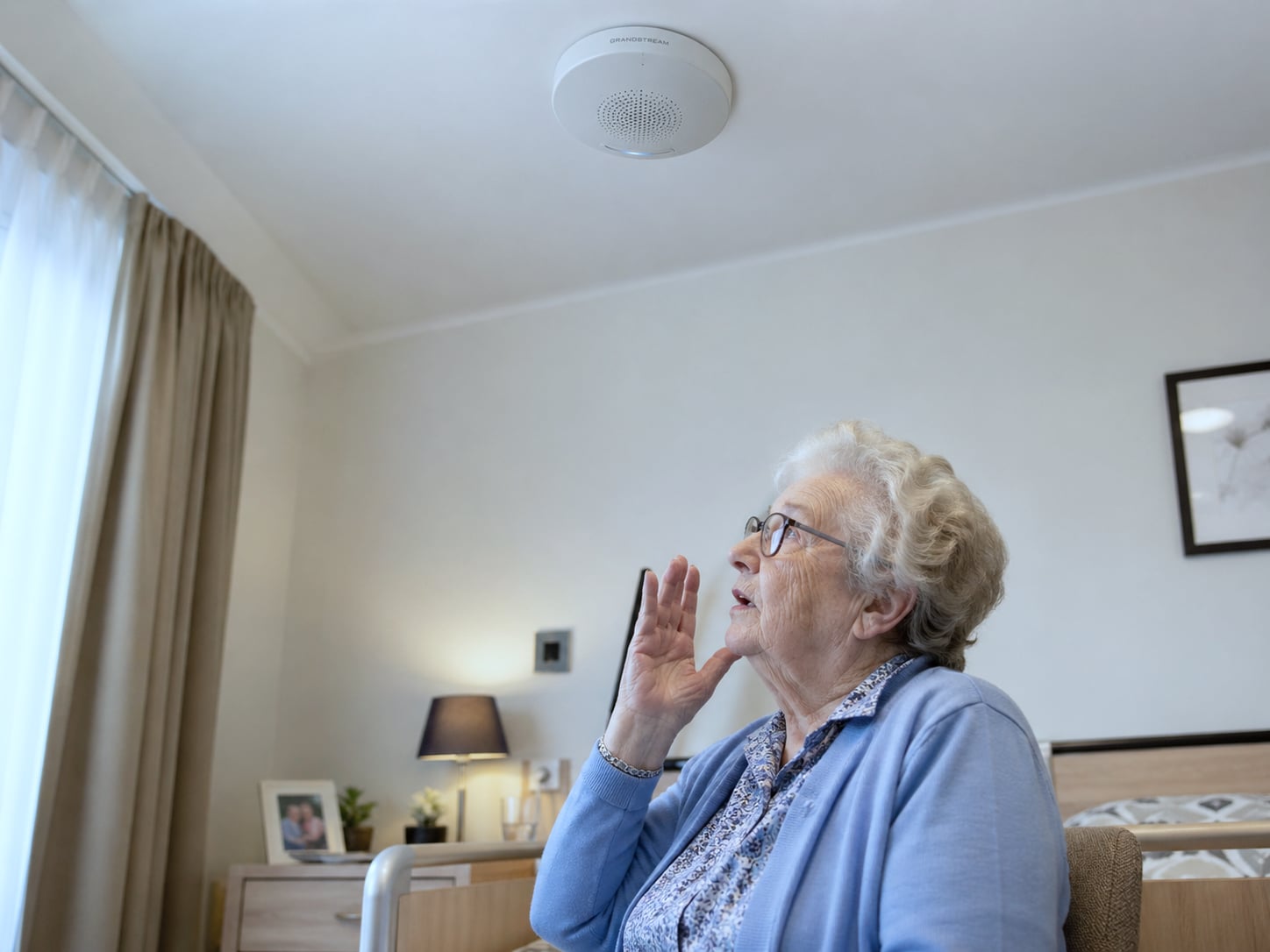
What is Healthcall IP intercom?
Healthcall IP intercom is a two-way audio communication layer deployed in your care home, natively integrated with nurse call and access control. It relies on standard SIP stations (Snom, Grandstream) registered on a 3CX central or any compatible IPBX, with no proprietary hardware imposed.
3 uses coexist on a single infrastructure: corridor intercoms with signal lamp to indicate a call state and dialogue with supervision, optional room intercoms for dual call/communication use, and the main-entrance intercom with electric strike and optional camera to filter visitors.
The system is designed for the real constraints of the Belgian care home: sometimes-old buildings, noisy zones (dining, technical room), small teams, limited night-time presence, multi-site care home groups with shared supervision. The publisher Groovit, an independent non-manufacturer integrator based in Frasnes-lez-Anvaing, has been equipping around twenty facilities since 2017.
-
300-700 €
Per-station cost
hardware excl. VAT depending on model (corridor, entrance, room)
-
SIP 2.0
Open standard
compatible with 3CX and market IPBX
-
< 1 Mbit/s
Bandwidth
cumulative network peak for 80-bed care home
-
PoE
Power
no specific cabling, standard RJ45
For more: integration with nurse call · coupled access control.
Six features designed for the care home, not the office building
IP intercom has existed for twenty years in classic tertiary. We adapted it to care home realities: nurse call coupling, internet outage tolerance, access control integration, multi-site management, audio quality in noisy zones.
-
Corridor intercoms + signal lamp
Snom M9R, Grandstream GXP21xx wall-mounted PoE stations. Colour coding from room signal lamp: green handled, red unhandled, blue technical, yellow logistics. Audio always two-way.
-
Reinforced entrance intercom
Grandstream GDS37xx with optional 1080p camera, reinforced casing IP65 outdoor, electric strike control. Visitor video on supervision and front-desk smartphone or DECT.
-
Optional room intercom
For ICU-type configurations or sensitive units (Alzheimer): two-way audio with floor carer plus emergency key. Triggered by resident or carer remotely. Always traced.
-
Native nurse call integration
Same 3CX central, same dial plan, same priority rules. An emergency intercom interrupts an ongoing external call with explicit notification. No silo.
-
TLS + SRTP encryption + VLAN
Three security layers. Signalling TLS 1.2/1.3, RTP audio SRTP, dedicated voice VLAN. No recording by default. If activated, storage in Belgium with configurable retention.
-
Tolerance to internet outage
Local IPBX per site (physical or virtualised on the Healthcall server). Site-internal intercom calls work autonomously without internet. Continuity of service including main-entrance opening.
Visual coming soon
IP intercom mounted on a wall near the main entrance of a care home
From entrance press to door opening
The standard flow for the most frequent use: a visitor presses the main-entrance intercom button, supervision authenticates and opens. Whole chain in under 30 seconds.
- Press
Visitor → entrance station
Visitor presses the entrance intercom button. The station rings on the front-desk and floor-carer smartphone or DECT, with optional video stream from the integrated camera. Audio two-way activated.
- Authentication
Identification + decision
The receptionist or carer dialogues with the visitor, identifies them via video. Routes to the relevant resident's phone or floor carer if expected. Refusal possible with logged note for known undesirable visits.
- Action
Remote opening + traceability
Activation of the electric strike from the smartphone, DECT or supervision dashboard. Door opens for 5 to 10 seconds (configurable). Event logged: time, station, identified visitor (if known), reaction time.
3 scenes from equipped care homes
Family arrival outside opening hours
7:45 pm, after the front desk has closed. The daughter of Mrs L. arrives at the main entrance. She presses the intercom. The station rings on the night carer's smartphone with video stream of the visitor. The carer recognises her, dialogues 30 seconds, opens the door remotely. Logged event: time, identified visitor, opening duration. Mrs L. is informed her daughter is coming up. Two-level reaction, central for care homes with after-hours visiting.
Visitor at the wrong door
10:15 am. A delivery driver presses the intercom of the wing reserved for the protected unit (Alzheimer). The station rings on the front-desk smartphone with video. The receptionist redirects them to the main entrance via two-way audio. Door not opened. Event logged for security audit. The intercom also serves to filter the building's accesses.
Inter-floor call between carer and supervision
3:30 pm. The carer of floor 2 dialogues from a corridor intercom with the central supervision station to coordinate a transfer of equipment to room 24. Two-way audio, no need to move physically. Saved time, fluid coordination. Same infrastructure as the resident phone, no extra software.
IP intercom integrates into the ecosystem
Same 3CX central, same SIP dial plan, same supervision dashboard. One contract, one infrastructure, one billing line.
-
Nurse call
Emergency intercom call interrupts a non-priority external call. Routing rules common to all communication channels.
-
Access control
Door opening triggered by remote command from intercom, direct integration with maglock and electric strike. Logged together.
-
Resident phone
Same 3CX central. Resident can be reached from a relative via main-entrance intercom transfer, or directly via their dedicated number.
-
Central supervision
Single screen for ongoing intercom calls, with video stream from entrance, multi-station floor plan, opening logs.
To discover all modules: see the full ecosystem · compare to other market solutions.