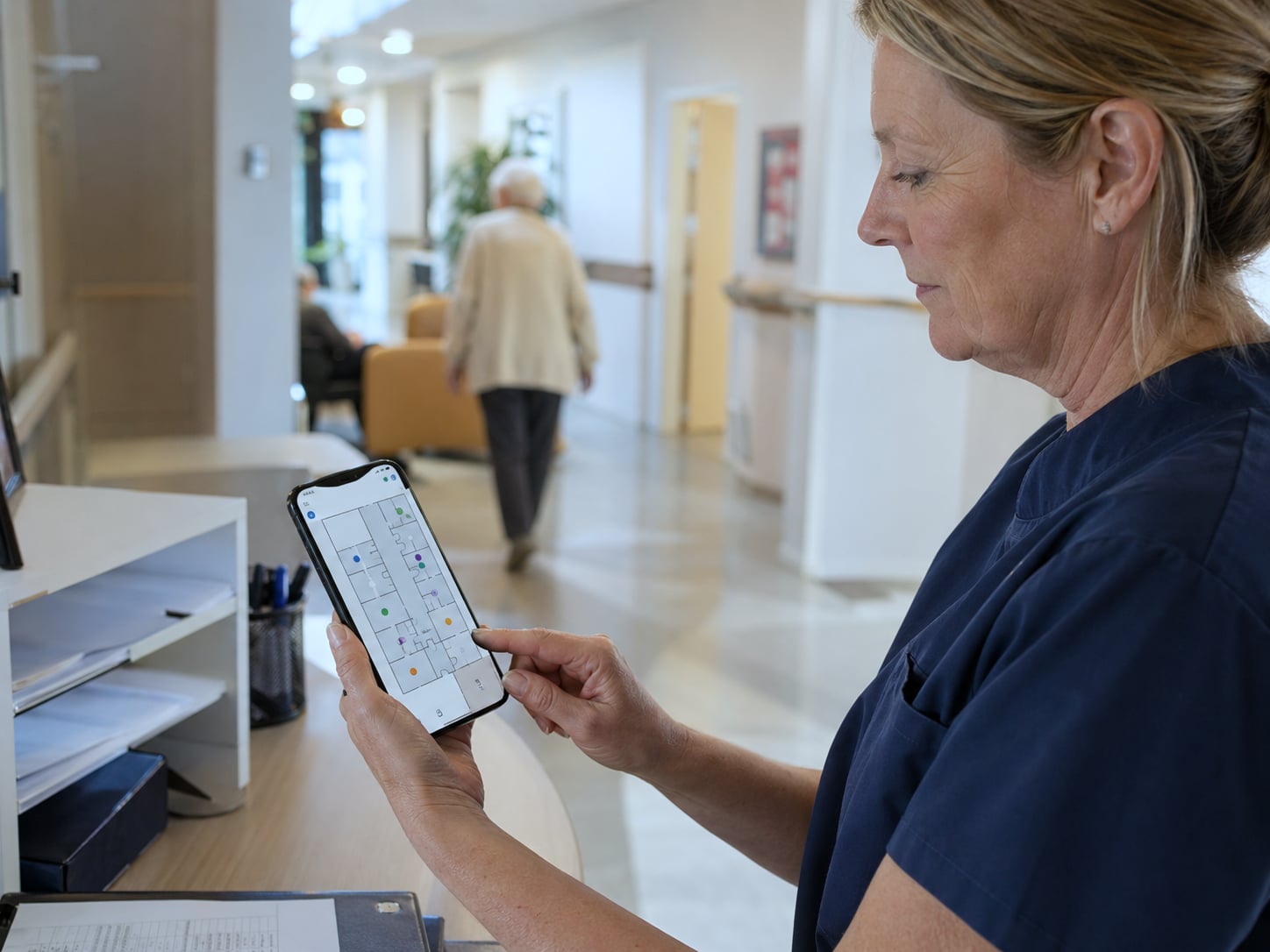
What is Healthcall resident tracking?
Healthcall resident tracking is a safety module combining indoor positioning via Bluetooth Low Energy (accuracy below 2 metres) and outdoor GPS for gardens, terraces and supervised excursions. The system displays the position of relevant residents in real time on a building plan, keeps an operational 30-day history, triggers alerts on forbidden-zone crossings and detects in-room presence to lighten carer action logging.
Deployment is the subject of consultation with your carers, your management and, depending on the case, the resident's legal representative or trusted person. Healthcall has been equipping around twenty Belgian care homes with this level of ethical demand since 2017.
-
< 2 m
BLE indoor accuracy
1 to 1.5 m in nominal conditions
-
36 mo
BLE wristband battery life
no recharge, < 15 g, IP67
-
30 days
Nominative history
then GDPR-compliant anonymous aggregation
-
Europe
Belgian hosting
premium private cluster, triple database
For more: complementary wandering prevention module · complete Healthcall ecosystem.
Six features, one coherent module
Each feature can be activated according to your context. You can start on the simple real-time plan with a partial BLE mesh, then progressively extend to configurable forbidden zones, outdoor GPS and long-term history.
-
BLE indoor < 2 m accuracy
Blueup or Sonitor mesh (one beacon every 8 to 12 metres in corridors). Position triangulated by local server with displayed confidence level. No false sense of certainty on degraded signal.
-
Outdoor GPS for garden and outings
Automatic switch as soon as the last BLE beacon is no longer read. Distinct marker on the plan. Activated only for residents whose profile justifies it, to limit recharging burden.
-
Real-time plan on tablet
Sober display: coloured points by alert, short ID by default, full name at one authenticated click. Built from your architectural plans. Filter by profile (e.g. Alzheimer residents for night rounds).
-
Configurable forbidden zones
Stairwells, doors leading to the street, technical zones, other residents' rooms. Defined by your head nurse. Cross-checked alert routed to smartphone or DECT plus supervision, with full traceability.
-
GDPR-native by design
Article 9 health data: documented legal basis, 30-day rolling history, DPIA provided, encrypted hosting in Belgium. Anonymisation by default on screens, named access via authenticated identification.
-
Long-term aggregated history
Beyond 30 days, anonymous statistics by zone, time slot, resident profile. Used to objectivise an Alzheimer wandering plan, identify underused zones, optimise garden access. No nominative cross-referencing.
Visual coming soon
Tablet displaying a care home floor plan with anonymised position points
From signal to alert in under two seconds
Each event follows the standard sequence: detection by BLE or GPS module, routing rule decision, carer action with full traceability.
- Detection
BLE or GPS signal → position
The wristband emits at regular intervals, captured by the nearest beacons. Triangulation < 2 m indoors, GPS fix outdoors. Whole chain in under 2 seconds with displayed confidence level.
- Decision
Rules per zone and profile
Authorised zones for the resident profile do not trigger an alert. Forbidden zone, lift, exterior door, other room: routing per configured rules. Critical alert + temporary door lock if Alzheimer wandering plan.
- Action
Carer + traceability
Smartphone or DECT receives alert with name + zone. Supervision sees the position on the plan. Doubt clearance, action log, automatic event closure. Every step timestamped for AViQ inspection.
3 scenes observed in equipped care homes
Disoriented resident in a corridor at 3 am
3:14 am. Mr T., advanced Alzheimer's resident, leaves his room and heads towards the central staircase. His BLE wristband is read by the corridor beacon. The zone is configured "alert if alone outside authorised hours". The terminal of the night carer rings in 2 seconds, displaying the position on the plan. The carer arrives in 50 seconds, walks Mr T. back to his room, closes the event with a short voice note. The next day, the head nurse adjusts the wandering plan with the coordinating physician.
In-room presence detection lightens action logging
Morning round. Sophie, care assistant, enters room 12 to handle Mrs L. Her BLE badge is read by the room beacon, presence detected automatically. On exit, she logs the action in 3 seconds via short list. No manual ID input, no double entry, the system already knows who, where, when. Saved time accumulates: 15 to 25 minutes per shift returned to direct care.
Garden outing without false alert
3 pm. Mr V., resident with mobility autonomy, leaves the building to enjoy the enclosed garden. The garden being declared an authorised zone for his profile, no alert is triggered. The system simply traces his presence in the garden zone for 25 minutes, then his return inside. The Quality Charter is respected: freedom of movement preserved, safety ensured by garden fencing and the wristband which would have alerted only if the main gate had been crossed.
Visual coming soon
Bright care home corridor with BLE beacon discreetly fixed on the ceiling
Resident tracking does not stand alone
The module shares its technical base with the whole Healthcall ecosystem. You are not stacking silos; you are extending a single system.
-
Wandering prevention
The sister module. Same BLE wristbands, same beacons, same routing rules. Wandering prevention adds critical-point detection and proportionate door locking.
-
Fall detection
Accelerometer wristbands geolocated via the same BLE beacons. A detected fall arrives with precise position on the smartphone or DECT, plus supervision plan view.
-
Nurse call
In-room presence detection automatically closes calls without the carer having to validate manually. Action logging shortened, focus stays on the resident.
-
Central supervision
Floor plan with positions, ongoing alerts, fire and intrusion alarms, active carers, a single screen. The duty station becomes a real control centre.
To discover all modules: see the full ecosystem · compare to other market solutions.