Access control for care homes: badges, codes and BLE wristbands
Access control for Belgian care homes: RFID/Mifare badges, codes per zone and schedule, automatic unlock for resident BLE wristbands, full traceability, anti-wandering integration. Since 2017.
Healthcall access control is a software layer that unifies all means of opening doors in your care home, badges, codes, resident BLE wristbands, mobile authentication, on a single zone, schedule and profile model. Each entry, exit and failed attempt is timestamped, geolocated and traced for regulatory and security purposes.
The module integrates natively with the rest of the ecosystem: a wandering prevention crossing can lock a door, an intercom call can unlock the main entrance, a fire alarm can switch the entire fleet to evacuation mode. All your access points, protected unit, pharmacy, technical zones, kitchen, main entrance, parking, are managed in a single interface.
Each feature is activatable according to your context. The system is designed to coexist with what is already installed and to add the missing functions.
RFID badges and short codes
Mifare 13.56 MHz badges for staff, short codes for shared zones, mobile authentication for management. Compatible Salto, Paxton, Nedap, Aperio. Single software layer.
Automatic resident BLE unlock
Wristband-wearing resident with profile-authorised zone unlocks doors automatically on approach. Other doors stay locked, attempt triggers wandering alert. Profile editable from dashboard.
Configurable zones and schedules
Pharmacy, kitchen, technical room, protected unit, main entrance with rules per profile and time slot. Logistics personnel only during the day, head nurse 24/7, family on appointment.
Failed attempt and intrusion alert
Repeated badge failures trigger an alert on the smartphone or DECT of the head nurse. Tail-gating detection if BLE camera-pair-presence available. Tracing for security audit.
Fire panel integration
Coupling via dry contact or dedicated bus. Fire doors switch to degraded evacuation mode automatically. Healthcall complements your fire system, never replaces it.
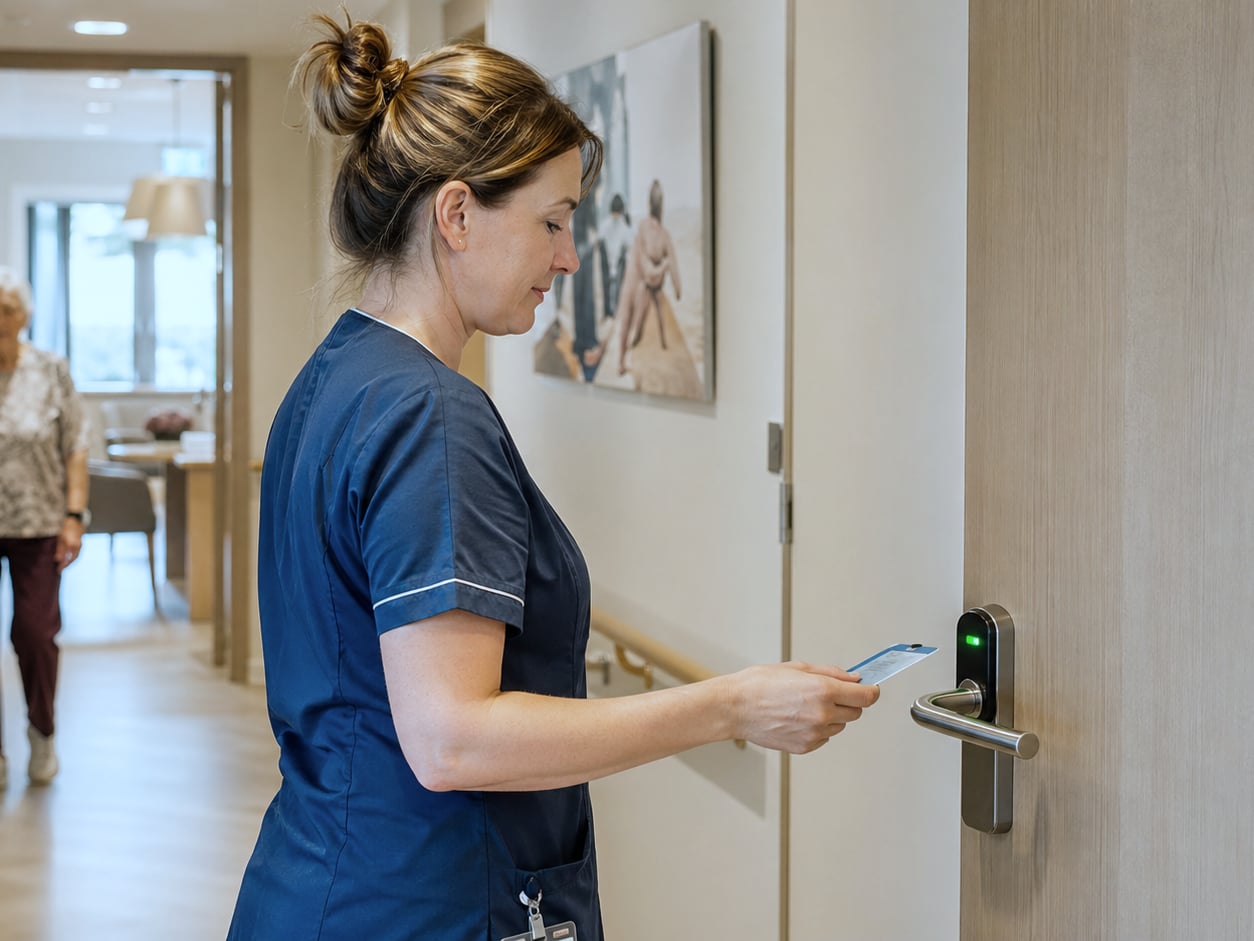
Care home protected unit door equipped with a discreet RFID badge reader and a colour signal lamp
RFID + BLE access, staff badge or resident wristband. Illustrative visual (client shoot to be produced).
3 scenes from equipped care homes
Lost badge revoked in 8 seconds
Mr T., night carer, loses his badge in town. He notifies his head nurse the next morning. She opens the dashboard, deactivates the badge in 3 clicks, reassigns a new one with same profile. From this minute on, the lost badge no longer opens any door, and any attempted use is logged as a failed attempt at the door concerned. No risk of unauthorised access during the period before discovery.
Resident with autonomy circulating freely
Mrs A., autonomous resident equipped with a wristband at her own request, moves freely through the ground floor and the secured garden. The corridor doors automatically unlock on her approach. The main exit door stays locked, it is not in her authorised circuit. Daily comfort preserved, wandering safety maintained for residents at risk.
Pharmacy access logged
The pharmacy keeps medication accessible only to authorised staff. Every entry is logged with badge ID, time, exit time. In case of inventory dispute, the head nurse extracts the period log. This traceability is also a quality argument for the AViQ inspection.
Access control integrates into the ecosystem
Same beacons, same server, same supervision. You are not stacking silos.
Wandering prevention
Detected crossing can lock a door temporarily. Wristband + access integrated on the same BLE layer.
IP intercom
Main-entrance intercom call paired with electric strike opening. Single 3CX central, single dashboard.
Central supervision
Single screen for accesses, calls, fire alarms. Real-time floor map with door states (open / closed / forced).
Nurse call
Same carer terminal (smartphone or DECT) receives tail-gating alerts and call alerts. No separate management.
Is Healthcall access control compatible with our existing system?
In most cases, yes. Healthcall interfaces with standard door controllers (RFID 13.56 MHz Mifare readers, Wiegand readers, electric strikes, maglocks, motorised locks) as well as with main market systems (Salto, Paxton, Nedap, Aperio). Depending on your installation state, three scenarios are possible: software integration above the existing fleet, partial replacement of incompatible readers, or new install. A free technical audit specifies the chosen scenario before any proposal. Our independent non-manufacturer integrator positioning lets us choose the best-suited field equipment, no proprietary catalogue to defend.
How much does adding an extra door cost?
The cost of an extra door varies on three factors: the strike or lock to equip (from 80 € excl. VAT for a simple strike to several hundred euros for a high-security motorised lock), the reader (standard RFID badge, code keypad, mixed reader), and any cabling needed if the door is not already served. For a care home already equipped with Healthcall, software activation of an extra door is included in the maintenance contract, no additional licence cost. A detailed line-by-line quote is provided after on-site audit, no opaque package.
What happens if a carer loses their badge?
Revocation is immediate from the Healthcall dashboard by your head nurse or management. The lost badge ID is deactivated on all facility doors in seconds, no intervention on each reader. A replacement badge is reassigned and activated immediately, with the same profile and rights. The revoked badge history remains consultable for audit. Until found and deactivated, any attempted use is logged as a failed attempt. For visitors, badge life is short by design, the risk is therefore contained.
How does access control work during a fire alarm?
Fire doors switch automatically to a degraded mode compatible with Belgian ERP regulations. Depending on the chosen configuration and each door's role in the evacuation plan, two behaviours coexist: general unlock to ease evacuation, or maintenance of fire compartments with manual interior opening. Coupling with the fire panel is via dry contact or dedicated bus, validated by your certified installer. Healthcall does not replace the fire panel: it interfaces with it. Switch tests are part of the facility's periodic verification plan.
How do you manage GDPR compliance for access traceability?
Access logs are personal data: they fall under GDPR and require precise framing. Healthcall applies several safeguards by design. Configurable retention period by your DPO (default 12 months, adjustable). Documented purposes (security, regulatory traceability, incident investigation). Log access restricted by profile, only management and head nurse consult full logs. Exports are timestamped and traced. Data remains hosted in Belgium, in the premium high-availability private cluster, no sub-contracting outside the EU. The GDPR data processing agreement is provided at signing.
Do you offer biometrics?
Yes, optional, and only when it brings real value without disproportionate GDPR risk. Healthcall supports fingerprint recognition on dedicated readers for a limited number of high-stake zones (pharmacy, medication storeroom, server room). We discourage biometrics for everyday carer access: operational efficiency does not match badge or BLE wristband performance, and fingerprints are sensitive biometric data under GDPR. Any biometrics activation follows an impact assessment (DPIA) jointly documented with your DPO. The final choice is yours.
Do resident BLE wristbands really unlock all doors of the authorised circuit?
Yes, to the second. The BLE wristband worn by a resident whose profile authorises certain zones (lounge, secured garden, their unit corridor) automatically unlocks the corresponding doors when the resident approaches. Doors of another unit, an unauthorised floor or the outside exit remain locked, and any attempt simultaneously triggers a wandering prevention alert. This mode smooths the daily life of autonomous residents without compromising safety for disoriented residents. The access profile is editable anytime from the dashboard, in line with the resident's evolving condition.